This article has multiple issues. Please help improve it or discuss these issues on the talk page. (Learn how and when to remove these messages)
This article provides insufficient context for those unfamiliar with the subject. Please help improve the article by providing more context for the reader.(April 2016) (Learn how and when to remove this message)
This article appears to be a dictionary definition. Please help expand it to present the subject encyclopedically.(April 2025) (Learn how and when to remove this message)
This article possibly contains original research. Please improve it by verifying the claims made and adding inline citations. Statements consisting only of original research should be removed.(November 2024) (Learn how and when to remove this message)
(Learn how and when to remove this message)
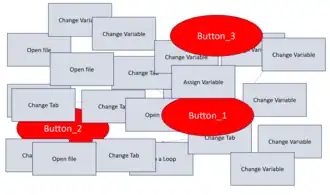
An example of interface bloat
Interface bloat is a phenomenon in software design where an interface incorporates too many (often unnecessary) operations or elements, causing issues such as difficulty navigating and usability.[1][2]
Definition
While the term bloat can refer to a variety of terms in software design,[3] Interface bloat refers to the phenomenon where the user interface (UI) becomes unnecessarily complex and overloaded with features, options, or elements that can overwhelm users.[4] This often leads to a cluttered experience, decreased usability, and increased difficulty for users to accomplish their tasks efficiently.[1][2] Interface bloat can arise from various sources, including the addition of excessive functionality without proper consideration of user needs, the merging of disparate features, or pressure to include numerous options to cater to a broader audience.[2]
^ abcAkiki, Pierre; Bandara, Arosha; and Yu, Yijun (24–27 June 2013). "The Open University's repository of research publications regarding minimizing the bloat in enterprise applications Conference Item". Fifth ACM SIGCHI Symposium on Engineering Interactive Computing Systems. London, UK. S2CID2935087.
^McGrenere, Joanna; Moore, Gale (15–17 April 2000). Graphics Interface. Montréal, Québec, Canada: Canadian Human-Computer Communications Society. pp. 187–196. ISBN 0-9695338-9-6. Retrieved 9 November 2024.