List of polyhedral stellations
 | This list is incomplete; you can help by adding missing items. (October 2018) |
In three-dimensional space, a stellation extends facets of a polyhedron to form a new figure. Usually, this is achieved by extending faces or edges and planes of a polyhedron, until they generate new vertices that bound a newly formed figure.
This article mainly lists various stellations belonging to uniform polyhedra, such as those of the regular Platonic solids and the semiregular Archimidean solids. It also lists stellations featuring unbounded vertices.
Stellation process
Coxeter et al. (1938) details, for the first time, stellations of the regular icosahedron with specific rules proposed by J. C. P. Miller. Generalizing these for stellating any uniform polyhedron yields the following set of rules:[1]
- The faces must lie in face-planes, i.e., the bounding planes of the regular solid.
- All parts composing the faces must be the same in each plane, although they may be quite disconnected.
- The parts included in any one plane must be symmetric about corresponding point groups, without or with reflection. This secures polyhedral symmetry for the whole solid.
- All parts included in planes must be "accessible" in the completed solid (i.e. they must be on the "outside").
- Cases where the parts can be divided into two sets, each giving a solid with as much symmetry as the whole figure, are excluded from consideration; combination of enantiomorphous pairs having no common part (which actually occurs in just one case) are included.
These rules are ideal for stellating smaller uniform solids, such as the regular polyhedra; however, when assessing stellations of other larger uniform polyhedra, this method can quickly become overwhelming — for example, there are a total of 358,833,072 stellations to the rhombic triacontahedron using this set of rules.[2] To address this, Pawley (1973) proposed a set of rules that restrict the number of stellations to a more manageable set of fully supported stellations that are radially convex,[3][4] such that an outward ray from the center of the original polyhedron (in any direction) crosses the stellation surface only once[5] (that is to say, all visible parts of a face are seen from the same side).
Lists
Lists for polyhedral stellations contain non-convex polyhedra; some of the most notable examples include:[a]
- the regular Kepler-Poinsot polyhedra (W20, W21, W22, and W41/C7)
- the regular compound polyhedra (W19, W2/C3, W24/C47, W25/C22, UC9) as well as
- compound dual polyhedra made of either Platonic solids or Kepler-Poinsot polyhedra (W19, W47, W61, W43, and the great icosahedron and great stellated dodecahedron compound)
Examples of stellations that topologically do not fit into standard definitions of uniform polyhedra are listed further down (i.e. stellations of hemipolyhedra).[6]
| Image | Name | Stellation core | Ref. | Notes |
|---|---|---|---|---|
 |
Great dodecahedron | Regular dodecahedron | W21 |
*, ¶
|
 |
Great stellated dodecahedron | W22
| ||
 |
Small stellated dodecahedron | W20
|
*
| |
 |
Great icosahedron | Regular icosahedron | W41,C7
| |
 |
Stellated octahedron | Regular octahedron | W19 |
†, ‡, ¶
|
 |
Compound of five tetrahedra | Regular icosahedron | W24,C47 |
†
|
 |
Compound of five octahedra | W2,C3
| ||
 |
Compound of ten tetrahedra | W25,C22
| ||
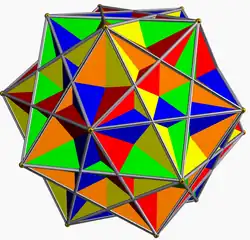 |
Compound of five cubes | Rhombic triacontahedron | ||
 |
Compound of great dodecahedron and small stellated dodecahedron | ‡
| ||
 |
Compound of dodecahedron and icosahedron | Icosidodecahedron | W47
| |
 |
Compound of great icosahedron and great stellated dodecahedron | W61
| ||
 |
Compound of cube and octahedron | Cuboctahedron | W43
| |
 |
Small triambic icosahedron | Regular icosahedron | W1,C2 |
¶
|
 |
Final stellation of the icosahedron | W13,C8
| ||
 |
First stellation of the rhombic dodecahedron | Rhombic dodecahedron |
- KEY
* Kepler-Poinsot polyhedron
† Regular compound polyhedron
‡ Platonic or Kepler-Poinsot dual polyhedra
¶ First and/or outermost stellation
"Ref." (references) such as indexes primarily found in Coxeter et al. (1999) using the Crennells' illustration notation (C), and Wenninger (1971) (W).
"Stellation core" describes the stellated regular (Platonic), semi-regular (Archimedean), or dual to a semi-regular (Catalan) figure (unless otherwise stated).
Stellations of the octahedron
The stella octangula (or stellated octahedron), is the only stellation of the octahedron, a regular polyhedron.[10] This stellation is made of self-dual tetrahedra, as the simplest regular polyhedral compound:[11]
| Figure | Stellation |
|---|---|
Stellated octahedron
stella octangula | |
 |
 |
Different from the larger, regular self-dual polyhedral enantiomorphisms (such as in the compound of five cubes), the tetrahedron is the only Platonic solid to generate a stellation (and regular polyhedron compound) from a single intersecting copy of itself.[c] Like the cube, the regular tetrahedron does not generate stellations when extending its faces, since all are adjacent (this yields only one possible convex hull).[10]
Stellations of the icosahedron
Coxeter et al. (1938) details stellations of the regular icosahedron with (aformentioned) rules proposed by J. C. P. Miller. The following table lists all such stellations per the Crennells' indexing, as found in Coxeter et al. (1999). In this list,[d] the regular icosahedron (or snub octahedron) stellation core is indexed as "1":
| 1 | 2 | 3 | 4 | 5 | 6 | 7 | 8 | 9 | 10 | 11 | 12 | 13 | 14 | 15 | 16 | 17 | 18 | 19 | 20 | 21 | 22 | 23 | 24 | 25 | 26 | 27 | 28 | 29 | 30 | 31 | 32 | 33 | 34 | 35 | 36 | 37 | 38 | 39 | 40 | 41 | 42 | 43 | 44 | 45 | 46 | 47 | 48 | 49 | 50 | 51 | 52 | 53 | 54 | 55 | 56 | 57 | 58 | 59 | |
|---|---|---|---|---|---|---|---|---|---|---|---|---|---|---|---|---|---|---|---|---|---|---|---|---|---|---|---|---|---|---|---|---|---|---|---|---|---|---|---|---|---|---|---|---|---|---|---|---|---|---|---|---|---|---|---|---|---|---|---|
Figure
|

|

|

|

|

|

|

|

|

|

|

|

|

|

|

|

|

|

|

|

|

|

|

|

|

|

|

|

|

|

|

|

|

|

|

|

|

|

|

|

|

|

|

|

|

|

|

|

|

|

|

|

|

|

|

|

|

|

|

|
A
|
B
|
C
|
D
|
E
|
F
|
G
|
H
|
e1
|
f1
|
g1
|
e1f1
|
e1f1g1
|
f1g1
|
e2
|
f2
|
g2
|
e2f2
|
e2f2g2
|
f2g2
|
De1
|
Ef1
|
Fg1
|
De1f1
|
De1f1g1
|
Ef1g1
|
De2
|
Ef2
|
Fg2
|
De2f2
|
De2f2g2
|
Ef2g2
|
f1
|
e1f1
|
De1f1
|
f1g1
|
e1f1g1
|
De1f1g1
|
f1g2
|
e1f1g2
|
De1f1g2
|
f1f2g2
|
e1f1f2g2
|
De1f1f2g2
|
e2f1
|
De2f1
|
Ef1
|
e2f1g1
|
De2f1g1
|
Ef1g1
|
e2f1f2
|
De2f1f2
|
Ef1f2
|
e2f1f2g1
|
De2f1f2g1
|
Ef1f2g1
|
e2f1f2g2
|
De2f1f2g2
|
Ef1f2g2
|
Wenninger (1971) includes a subset of these as formal stellations, primarily based on illustrative methods of construction of stellated polyhedral models (and extending to stellations of the icosidodecahedron). While only one stellation of the icosahedron is a Kepler-Poinsot polyhedron, all stellations of the dodecahedron are Kepler-Poinsot polyhedra (the remaining).
Hemipolychrons
In Wenninger (1983), a unique family of stellations with unbounded vertices are identified.[6] These originate from orthogonal edges of faces that pass through centers of their corresponding dual hemipolyhedra. The following is a list of these (with coincidental figures in parentheses).
| Image | Name | Stellation core |
|---|---|---|
 |
Tetrahemihexacron | Tetrahemihexahedron |
 |
Hexahemioctacron (octahemioctacron) |
Octahemioctahedron |
 |
Small dodecahemidodecacron (small icosihemidodecacron) |
Small icosihemidodecahedron |
 |
Great icosihemidodecacron (great dodecahemidodecacron) |
Great dodecahemidodecahedron |
 |
Small dodecahemicosacron (great dodecahemicosacron) |
Great dodecahemicosahedron |
This family of stellations does not strictly fulfill the definition of a polyhedron that is bound by vertices, and Wenninger notes that at the limit their facets can be interpreted as forming unbounded elongated prisms. Of these, only the tetrahemihexahedron would produce a stellation without another coincidental figure, the tetrahemihexacron.
See also
- List of uniform polyhedra (listed stellated Wenninger W19–W66 forms exclude non-regular solids, as well as compounds)
References
Notes
- ^ Using index notation from Coxeter et al. (1999) (C), the Crennells' third edition of The Fifty-Nine Icosahedra, and Magnus Wenninger's notation as found in Wenninger (1971) (W), where applicable.
- ^ Forms a honeycomb with copies of itself.
- ^ Regular compound polyhedra larger than the stellated octahedron are made of larger sets of regular polyhedra with chiral symmetry.
- ^ "Cell" corresponds to the internal spaces formed by extending face-planes of the regular icosahedron (du Val notation). In a symmetric figure such as the regular icosahedron, these cell types form groups or sets of congruent cells, unique to each stellation — a set of cells forming a closed layer around its core forms a shell, which can be made of multiple types (e.g., e comprises e1 and e2).
Works cited
- ^ Coxeter et al. (1938), pp. 7, 8.
- ^ Messer (1995), p. 26.
- ^ Wenninger (1983), pp. 36.
- ^ Messer (1995), p. 27.
- ^ Webb.
- ^ a b Wenninger (1983), p. 101.
- ^ Pawley (1975).
- ^ Weisstein.
- ^ Coxeter (1973).
- ^ a b Coxeter (1973), p. 96.
- ^ Coxeter (1973), pp. 48, 49.
- Sources
- Coxeter, H. S. M. (1973). Regular Polytopes (3rd ed.). New York: Dover. ISBN 0-486-61480-8.
- Coxeter, H. S. M.; du Val, P.; Flather, P.; Petrie, J. F. (1938). The Fifty-Nine Icosahedra. University of Toronto Studies (Mathematical Series) (6th ed.). University of Toronto Press.
- Second edition: Coxeter, H. S. M.; et al. (1982). The Fifty-Nine Icosahedra. New York: Springer-Verlag. ISBN 978-0-387-90770-3.
- Third edition: Coxeter, H. S. M.; et al. (1999). The Fifty-Nine Icosahedra. Illustrations by Kate and David Crennell. Tarquin. pp. 1–72. ISBN 978-1899618323.
- Messer, Peter W. (1995). "Stellations of the rhombic triacontahedron and beyond" (PDF). Structural Topology (21). Structural Topology Research Group (University of Montreal): 25–46. ISSN 0226-9171.
- Pawley, G. S. (1975). "The 227 triacontahedra". Geometriae Dedicata. 4 (2–4): 221–232. doi:10.1007/BF00148756. S2CID 123506315.
- Pawley, G. S. (1973). "Stellated triacontahedra" (Document). Unpublished manuscript.
- Webb, Robert. "Stella Polyhedral Glossary". Stella.
- Weisstein, Eric W. "Great Dodecahedron-Small Stellated Dodecahedron Compound". MathWorld. Wolfram Research.
- Wenninger, Magnus (1971). Polyhedron Models. Cambridge University Press. pp. 1–220. ISBN 0521069173.
- Wenninger, Magnus (1983). Dual Models. Cambridge University Press. pp. 1–208. doi:10.1017/CBO9780511569371. ISBN 0521098599. MR 0730208.
External links
- Stella Polyhedral Glossary from Stella (Robert Webb) for a list of relevant terminology regarding stellations
- Enumeration of Stellations lists counts of stellations for Platonic and Archimedean solids, as well as select prisms and antiprisms
- 59 Stellations of the Icosahedron from Virtual Polyhedra (George W. Hart)
- Icosahedron Stellations from Mathworld (Eric W. Weisstein) - contains an image of all stellations based on the icosahedron (per Coxeter)