United States Naval Sea Cadet Corps
| United States Naval Sea Cadet Corps | |
|---|---|
 Official seal of the United States Naval Sea Cadet Corps | |
| Founded | September 10, 1958 |
| Country |  United States United States |
| Type | United States Navy, Coast Guard, sponsored organization[1] |
| Role | Youth development program |
| Size | 325 units[2] |
| Part of | Navy League of the United States |
| Nickname(s) | Naval Sea Cadet Corps, Sea Cadets |
| Motto(s) | "Honor, Respect, Commitment, and Service" |
| Colors | Navy blue and dress white |
| March | ⓘ |
| Anniversaries | 10 September |
| Former ship | USNSCS Grayfox[3] |
| Website | www |
| Commanders | |
| Executive director | RADM Andrew Lennon, USN (Retired) |
| Chief of staff | Vicki Powell |
| National chairman | Larry Salter |
The United States Naval Sea Cadet Corps (USNSCC or NSCC) is a congressionally chartered organization sponsored by both the United States Navy and the US Coast Guard. It serves as the official youth program of the Navy and the Coast Guard.[4] Sea Cadets wear US Navy uniforms adorned with the organizations official insignia, attend monthly drills and recruit training, and can earn advanced enlistment pay grades (often E‑3) in the US Navy; however participation, does not obligate any individual to enlist in the military.[5][6] Currently, the organization comprises 5,600 Sea Cadets, aged 13 to 17, across various facilities nationwide.[7][8] Approximately 325 units are located in the United States, Guam, and Puerto Rico.[9]
The United States Naval Sea Cadet Corps historically had one vessel registered as the USNSCS Grayfox and was managed by the Navy Reserve. The vessel is undeployable and made its last trip to sea on 26 April 1998. It is not in active service, and is at port in Port Huron, Michigan. In present times the organization still relies heavily on the military support for both uniforms and equipment as well as securing its funding.[10] The United States Navy a major presence, deploying its strength in areas such as the Western Pacific, the Mediterranean, and the Indian Ocean. Due to their presence in several regions the Sea Cadets receive a wide variety of Equipment of the United States Navy, chartered by the Navy to increase its outreach in not only the United States, but also internationally and provides multiple benefits for international youth that might consider participating in the organization.[11][12]
The United States Naval Sea Cadet Corps was established by the Navy League of the United States, at the request of the Secretary of the Navy.[13][14] It was recognized federally to foster interest in the Navy among young people. It officially allowed young women to join in 1974.[15] In addition to military training[16] and leadership development, the organization emphasizes a structure of character building, civic responsibility, and community service. Sea Cadets participate in activities including, but not limited to, seamanship, firefighting, damage control, field medical training, and STEM. Sea Cadets can also take part in public service projects, parades, and commemorative events.[17]
Mission
The mission of the United States Naval Sea Cadet Corps is to build leaders of character by imbuing in our cadets the highest ideals of honor, respect, commitment, and service.
— Mission statement of the United States Naval Sea Cadet Corps[18]
The United States Naval Sea Cadet Corps three primary areas of responsibility are:
- The development of leadership skills and character among cadets through structured training and mentorship.[19][20]
- The provision of hands-on training in various disciplines, including field operations and specialized military techniques.[21]
- The preservation and education of naval history and heritage.[22][23]
US Sea Cadet training manuals state: "the primary tools to be used to train cadets and develop their character, military bearing, and self control are leadership (by perfect example, inspiration, and motivation) and mentorship (by instruction and concern for personal development)." [24][25][26]
History
Origins

The United States Naval Sea Cadet Corps was established in 1958 by the Navy League of the United States at the request of the Department of the Navy. Conceived as a means to foster interest in naval service among American youth, the program was met with a positive public reception and received a balanced growth in both the number of local units and youth participants.[9] In 1962, the USNSCC was formally recognized by the United States Congress through the passage of Public Law 87–655,[28] which granted the organization a federal charter as a non-profit civilian entity.[29] This legislation delineated the United States Naval Sea Cadet Corps corporate structure and operational authority, distinguishing it legally from the Navy League of the United States while emphasizing its mission to train American youth through cooperation with the Department of the Navy.[30] The stated purpose of the Corps under the charter was "to encourage and aid American youth to develop an interest and skill in basic seamanship and in its naval adaptations, to train them in seagoing skills, and to teach them patriotism, courage, self-reliance and kindred virtues." [31][32][33]
20th century
During the 20th century, the United States Naval Sea Cadets were brought to valuable exposure to several events in their lives.[34] The Sea Cadets operated with minimal shipboard training and received operational and educational experiences in collaboration with active-duty personnel.[16][35][36] The USNSCC worked to instill a sense of patriotism and service in youth, often aligning its training efforts with current naval operations and exercises.[37] The Sea Cadets served as a tool in fostering early interest in naval careers, allowing a gateway into supplementing several recruitment pipelines, and building public support for the Navy's mission.[38][39][19] One of the most integral parts,[37] in connection with the Naval Sea Corps mission, was to live a "gang free lifestyle".[40] Instilled with support and influence of the United States Drug Enforcement Administration.[37][41]
21st century
United States Naval Sea Cadet Corps remains an active, Navy and Coast Guard – sponsored, youth development program operating in the United States and its territories.[42] The United States Navy League is divided into two organizations: the Navy League Cadet Corps for ages 10 to the end of Eighth grade, and the United States Naval Sea Cadet Corps, for youth aged 13 to the end of high school.[43][44][45] The USNSCC now includes 325 units distributed across 46 states, Guam and Puerto Rico; involving approximately 5,600 Sea Cadets and over 2,600 adult volunteers which contribute to numerous voluntary service hours each year.[46] [47][7] The Executive Director of the USNSCC is personally responsible for making sure the organization receives funding.[48] The United States Navy League have established recent opportunities in the Great Lakes, and have instilled new operating schedules for naval ships to permit a prospect for further shipboard training, accompanied by a increase within its recruitment numbers.[49]
Organization
The United States Naval Sea Cadet Corps operates in ways that are unique from the United States Armed Forces and in terms of the organization itself, it is not deployable. The USNSCC receives support from the United States Navy and Coast Guard, which provide resources and training assistance to ensure effective operations.[50][51] All ranks in the organization are honorary and does not grant the authority, privileges, or entitlements of active duty military ranks in the United States.[52] The Executive Director is entitled to recruiting, training, organizing, and equipping the organization to maintain readiness and compliance with all program standards. An individual who serves as the leadership position is responsible for the overall management of all Sea Cadets. This position is held by Executive Director Andrew Lennon.[53][54] International Sea Cadet organizations are known to exist in most areas of the world, and in addition there is a similar version known as the Navy League Cadet Corps, for children ten and up to Eighth grade.
Local training
Each unit may vary, though typically in a classroom setting, with well trained professional volunteers though, with specific settings can be with service members of the United States Armed Services. The activities in the organization can include going on field trips, learning naval history and traditions.[55][19] Though, for most Sea Cadets their first three months of training are at their local unit's facility. But later on Sea Cadets may choose to go on educational tours and more unique field trips. The organization has an operation known as "the first two weeks" and is a requirement for all Sea Cadets and must be passed to continue further into training.[56] The location that Sea Cadets trained is Navy bases or recruitment centers typically, but can be other branches of the United States Armed Services and their recruitment centers. Often, after their first several months the Sea Cadets will go on field trips on boats while other activities can include meeting service members of various US armed forces.[57]
Support and logistics

Several installations and facilities span across the states and US territories.[59][60] Mainly Coast Guard and Navy operated, the installations and facilities serve as to benefit the Sea Cadets on land, receive education away from home. The installations and facilities serving the United States Naval Sea Cadet Corps are the administrative, recruiting and logistical framework that support the organization.[22] Typically handling policy implementation, training coordination, personnel management, and supply distribution. The national headquarters, located in Arlington, Virginia[61] oversees program operations, manages databases, and enforces compliance with Navy guidelines and youth protection standards. Beyond their logistical roles, installations also serve as key cultural and ceremonial centers for the Sea Cadets. Hosting events such as change of command ceremonies, promotion boards, award presentations, and graduation parades, reinforcing traditions and fostering the spirit in the corps among Sea Cadets and officers alike.[62]
Relationship with the United States Coast Guard

US Coast Guard support for the United States Naval Sea Cadet Corps has evolved over time, but became more formalized in the 1960s.[63] The USNSCC was established in 1958 by the Navy League of the United States, and in 1962 it was chartered by United States Congress as a youth program with support of the United States Navy. While the Navy had been the primary supporting force, the Coast Guard has been involved in various capacities, particularly in areas, for maritime training and leadership development, which are key components of the USNSCC program.[64] Sea Cadets go on Navy and Coast Guard vessels and small craft, serving as a role in their training.[65]
Equipment
Training equipment
_off_Honolulu.jpg)
The United States Naval Sea Cadet Corps trains on multiple different training vehicles primarily operated and owned by the United States Navy and US Coast Guard.[24] Vehicles range from patrol boats, cutters, rigid-hull inflatable boats (RHIBs), and historically decommissioned naval vessels repurposed for instructional use. This provides an experience into military life and may inspire future service in the armed forces.[11] The former USNSCS Grayfox (TWR-825) was the largest ship operated by the USNSCC it is homeported in Port Huron, Michigan. And had served as a primary platform for shipboard training and maritime education. Originally commissioned as a Torpedo Weapons Retriever by the US Navy in the 1980s, the Grayfox later transferred to the USNSCC were it was converted into a training ship.[66] It was maintained through a joint-effort between the Navy Reserve, local Sea Cadet units, and volunteers.[66]
Safety equipment
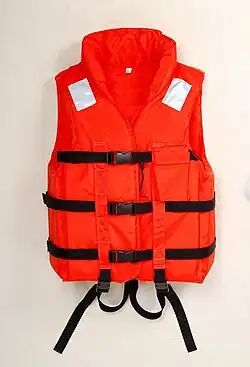
Sea Cadets have a assortment of safety equipment and are required to wear United States Coast Guard certified personal flotation devices (or PFDs) compliant with Title 46 Code of Federal Regulations Part 160.[68] The PFDs, are traditionally Type I and Type III PFDs, and are essential in maintaining buoyancy during accidental immersion scenarios typical during shipboard and small craft maritime exercises.[69] The PFDs are used in both civilian maritime safety standards and military operational readiness. Damage control and firefighting training within the United States Naval Sea Cadet Corps is executed safely by using fire resistant uniforms meeting NFPA 2112 certification, alongside with self-contained breathing apparatus (SCBA) and other protective gear.[68] This ensemble replicates the protective equipment employed by active-duty service members, thus providing Sea Cadets with exposure to shipboard emergency protocols while maintaining safety standards established by the National Fire Protection Association.[70][71][68] Such training occurs in controlled environments replicating naval vessel conditions, emphasizing proficiency in emergency containment, fire suppression, and flooding response.[72]
Ranks
| Rank | Correspondence course | Training | Time in rate | Time in service | Exam | Approval authority |
|---|---|---|---|---|---|---|
| No Insignia,
Must Reach SC-2.
|
None | None | None | 0 months | Basic Military Requirement Booklet | Recruiting officer |

SC-2 Seaman apprentice (SA) |
Polaris advancement course: E-2: Seaman | NSCC recruit training | 3 months in NSCC | 3 months | Polaris advancement Test: E-2: Seaman | Commanding officer |

SC-3 Seaman (SN) |
Polaris advancement course: E-3: Seaman[74] | Advanced training (Minimum 7 days) | 6 months as SC-2 | 9 months | Polaris advancement Test: E-3: Seaman[74] | Commanding officer |
|
SC-4 Petty officer 3rd Class (PO3) |
Petty officer: 3rd and 2nd class[75] | Advanced training (Minimum 7 days) | 6 months as SC-3 | 15 months | PO3 exam | Commanding officer |

SC-5 Petty officer 2nd class (PO2) |
Petty officer 3rd and 2nd class NAVEDTRA-14504[76] |
Advanced training (minimum 7 days), must have graduated from POLA (Petty Officer Leadership Academy) | 6 months as SC-4 | 21 months | PO2 exam | Commanding officer |

SC-6 Petty officer 1st class (PO1) |
Petty officer 1st class NAVEDTRA-14145[77] |
Advanced training (minimum 7 days) | 6 months as SC-5 | 27 months | PO1 exam | NSCC Executive Director |
.png)
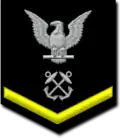
SC-7 Chief petty officer (CPO) |
Chief petty officer NAVEDTRA-14144[78] |
Advanced training (minimum 7 days) Staff RT (effective 1 September 2008) Be 16 years of age |
6 months as SC-6 | 33 months | CPO Exam | NSCC Executive Director |
Medals
| List of medals used in the United States Naval Sea Cadet Corps.[79] | ||

Naval Sea Cadet Corps 50th Anniversary Ribbon |
 Naval Sea Cadet Corps Academic Achievement Ribbon |

Naval Sea Cadet Corps Citation Ribbon. |

Naval Sea Cadet Corps Outstanding Cadet Award |

Naval Sea Cadet Corps Community Service Ribbon |

Naval Sea Cadet Corps Color Guard Ribbon |

Naval Sea Cadet Corps Drug Reduction Ribbon |

Naval Sea Cadet Corps Fifth Year Ribbon |

Naval Sea Cadet Corps First Year Ribbon |

Naval Sea Cadet Corps International Ribbon |

Naval Sea Cadet Corps Honor Ribbon |

Fourth Year Ribbon |

Naval Sea Cadet Corps Meritorious Recognition Ribbon |

Naval Sea Cadet Corps Merit Ribbon |

Naval Sea Cadet Corps Marksman Ribbon |

Naval Sea Cadet Corps NSCC Escort Officer Ribbon. |

Naval Sea Cadet Corps NLUS Youth Ribbon. |

Naval Sea Cadet Corps NLCC Distinguished Service Ribbon |

Naval Sea Cadet Corps NSCC IEP Ribbon |

Naval Sea Cadet Corps NSCC NLCC Service Ribbon |

Naval Sea Cadet Corps Physical Fitness Ribbon |

Naval Sea Cadet Corps Science Achievement Ribbon |

Naval Sea Cadet Corps SAR Citizenship Award |

Naval Sea Cadet Corps Recruiting Incentive Ribbon |
 Naval Sea Cadet Corps Third Year Ribbon |

Naval Sea Cadet Corps Staff Cadet Ribbon |
 Naval Sea Cadet Corps Second Year Ribbon |

Naval Sea Cadet Corps Unit Commendation Ribbon |

Naval Sea Cadet Corps USCG Bicentennial Unit Commendation Ribbon |

Naval Sea Cadet Corps VFW NSCC Ribbon |
See also
- Navy League of the United States
- Navy Junior ROTC
- Combined Cadet Force
- Cadets (youth program)
- International Sea Cadet Association
- Sea Cadets (various nations' Sea Cadet organizations)
- Sea Scout
- U.S. Naval Academy
- U.S. Merchant Marine Academy
- U.S. Coast Guard Academy
- Civil Air Patrol
- Naval Reserve Officers Training Corps
References
- ^ "36 U.S. Code § 154101 – United States Naval Sea Cadet Corps". Cornell Law School Legal Information Institute. Retrieved 7 July 2025.
- ^ https://www.seacadets.org/wp-content/uploads/2023/12/2023_USMC_Seafarer.pdf
- ^ Cumulative List of Organizations Described in Section 170 (c) of the Internal Revenue Code of 1986. Department of the Treasury, Internal Revenue Service. 2003.
- ^ "About – FDR Sea Cadets". FDR Sea Cadets. Retrieved 7 July 2025.
- ^ "Sea Cadet Advancement". FDR Sea Cadets. Retrieved 7 July 2025.
- ^ Curtin, Lisa Ane (1992). "A survey of factors related to participation in the Naval Junior Reserve Officer Training Corps program in selected Virginia public high schools". Virginia Polytechnic Institute and State University ProQuest Dissertations & Theses.
- ^ a b CAUSE IQ-United States Naval Sea Cadet Corps (USNSCC) "We train 5,600+ youth annually at 326 units in 46 states, Guam and Puerto Rico."https://www.causeiq.com/organizations/united-states-naval-sea-cadet-corps,520808385/
- ^ U.S. Naval Sea Cadet Corps Manual. ManualLib. 17 October 2023. Retrieved 5 July 2025.
- ^ a b Ruiz, Stephen (11 August 2021). "Everything You Need to Know About the US Naval Sea Cadet Corps". Military.com. Retrieved 1 July 2025.
- ^ Logistics), United States Assistant Secretary of Defense (Production and (1990). Defense Reutilization and Marketing Manual. Department of Defense, Office of the Assistant Secretary of Defense, Production & Logistics.
- ^ a b Coulter, John A. (24 March 2017). Cadets on Campus: History of Military Schools of the United States. Texas A&M University Press. ISBN 978-1-62349-521-3.
- ^ Daily, Space Coast (2 June 2019). "U.S. Naval Sea Cadet Chief Petty Officer Ethan Goswick Selected for International Exchange Program". Space Coast Daily. Retrieved 24 July 2025.
- ^ United States, Congress (10 March 2004) [2019]. Department of Defense Authorization for Appropriations for Fiscal Year 2005. Vol. 2. U.S. Committee on Armed Services (published 2019). p. 689. ISBN 9780243168644. Retrieved 22 July 2025.
- ^ "United States Code: Naval Sea Cadet Corps, 36 U.S.C. §§ 1541–1548". Library of Congress. U.S. Government. Retrieved 5 July 2025.
- ^ "About Us". orionsquadron.org. Retrieved 22 July 2025.
- ^ a b "United States Naval Sea Cadet Corps Regulations Manual". Docslib.org. Retrieved 5 July 2025.
- ^ "History of the USNSCC". United States Naval Sea Cadet Corps Spc. Justin O. Penrod Division. Retrieved 3 July 2025.
- ^ "FAQ". America's Sea Cadets. Retrieved 1 July 2025.
- ^ a b c Ruiz, Stephen (11 August 2021). "Everything You Need to Know About the US Naval Sea Cadet Corps". Military.com. Retrieved 3 July 2025.
- ^ "The Lessons Learned from Being in the US Naval Sea Cadet Corps". kibin.com. Retrieved 3 July 2025.
- ^ "Training and Development at the Naval Sea Cadet Corps". U.S. Naval Sea Cadet Corps. Retrieved 5 July 2025.
- ^ Cragg, Jennifer (8 November 2021). "U.S. Naval Sea Cadet Corps Florida-Based Battalion Dedicated to Preserving World War II History Through Personal Stories". seapowermagazine.org. United States Navy League. Retrieved 22 July 2025.
...these interviews serve as an excellent history and heritage teaching moment for our Sea Cadets.
- ^ U.S. Naval Sea Cadet Corps (1 December 2011). Advancement and Training Syllabus for the Navy League Cadet Corps. CreateSpace. ISBN 978-1468108002.
- ^ Noone, James A. (1995). "All Hands, Issues 933-944". All Hands (933): 16–22. CU14224151 – via Google Books.
- ^ Defense, United States Congress Senate Committee on Appropriations Subcommittee on (2003). Department of Defense Appropriations for Fiscal Year 2004: Hearings Before a Subcommittee of the Committee on Appropriations, United States Senate, One Hundred Eighth Congress, First Session, on H.R. 2658/S. 1382, an Act Making Appropriations for the Department of Defense for the Fiscal Year Ending September 30, 2004 and for Other Purposes. U.S. Government Printing Office. ISBN 978-0-16-070974-6.
- ^ States, United (1971). Seamen's Act as Amended and Other Laws Relating to Seamen. U.S. Government Printing Office.
- ^ "Public Law 87-655" (PDF). U.S. Government Publishing Office. Retrieved 7 July 2025.
- ^ "National Partners". corpslakes.erdc.dren.mil. Retrieved 3 July 2025.
- ^ "Cadet Advanced and Recruit Trainings". Mason Division DDG87. Retrieved 3 July 2025.
- ^ "History of the USNSCC". Seacadets DC. Retrieved 7 July 2025.
- ^ Fitch, Morgan L. (1970). "Objectives and Influence of the Navy League". Naval War College Review. 23 (1): 31–35. ISSN 0028-1484.
- ^ Vowinckel, Annette; Payk, Marcus M.; Lindenberger, Thomas (2012). Cold War Cultures: Perspectives on Eastern and Western European Societies. Berghahn Books. ISBN 978-0-85745-243-6.
- ^ Cumulative List of Organizations Described in Section 170 (c) of the Internal Revenue Code of 1986. Department of the Treasury, Internal Revenue Service. 2002.
- ^ Services, United States Congress House Committee on Armed. Hearings.
- ^ a b c Defense, United States Congress Senate Committee on Appropriations Subcommittee on Department of (2004). Department of Defense Appropriations: Hearings Before a Subcommittee of the Committee on Appropriations, United States Senate. U.S. Government Printing Office.
- ^ https://media.defense.gov/2025/Jul/11/2003752580/-1/-1/1/AHM-JULY2025%20WEB.PDF
- ^ "Ever Heard of the U.S. Naval Sea Cadets?". American Foreign Service Association. Retrieved 3 July 2025.
- ^ Defense, United States Congress Senate Committee on Appropriations Subcommittee on Department of (2008). Department of Defense Appropriations: Hearings Before a Subcommittee of the Committee on Appropriations, United States Senate. U.S. Government Printing Office.
- ^ Greenberg, Martin Alan (2 December 2024). Youth Involvement in Public Safety in the United States: Mitigating Youth Violence through Community Programming. Springer Nature. ISBN 978-3-031-74172-2.
- ^ Billoni, Michael. "Billoni:Impressed with US Naval Sea Cadet Corps". Niagara Frontier Publications. Archived from the original on 3 December 2024. Retrieved 25 July 2025.
- ^ "America's Sea Cadets - The US Navy's youth development program". America's Sea Cadets. Retrieved 11 July 2025.
- ^ "Who We Are". America's Sea Cadets. Retrieved 11 July 2025.
- ^ Streissguth, Thomas (1 September 2004). The U.S. Navy. Lerner Publications. ISBN 978-0-8225-1649-1.
- ^ Spivak, Wayne (2004). "The Naval Sea Cadet Corps Officer Corps". Duckworks Magazine. Retrieved 5 July 2025.
- ^ Ruiz, Stephen (11 August 2021). "Everything You Need to Know About the US Naval Sea Cadet Corps". Military.com. Retrieved 11 July 2025.
- ^ Ford, Michael D. (2009). "U.S. Naval Sea Cadet Corps 2009 Annual Report" (PDF). Defense Technical Information Center. Retrieved 5 July 2025.
- ^ Defense, United States Congress Senate Committee on Appropriations Subcommittee on Department of (2008). Department of Defense Appropriations: Hearings Before a Subcommittee of the Committee on Appropriations, United States Senate. U.S. Government Printing Office.
- ^ Defense, United States Congress Senate Committee on Appropriations Subcommittee on Department of (2011). Department of Defense Appropriations for Fiscal Year ...: Hearings Before a Subcommittee of the Committee on Appropriations, United States Senate, Ninety-fifth Congress, First Session-. U.S. Government Printing Office.
- ^ Defense, United States Congress Senate Committee on Appropriations Subcommittee on Department of (2008). Department of Defense Appropriations: Hearings Before a Subcommittee of the Committee on Appropriations, United States Senate. U.S. Government Printing Office.
- ^ Naval Reservist. 1957.
- ^ "USNSCC Leadership". United States Naval Sea Cadet Corps. Retrieved 7 July 2025.
- ^ Seafarer Magazine: The U.S. Naval Sea Cadet Corps Seafarer in this issue: celebrating achievements
- ^ Defense, United States Congress Senate Committee on Appropriations Subcommittee on Department of (2004). Department of Defense Appropriations: Hearings Before a Subcommittee of the Committee on Appropriations, United States Senate. U.S. Government Printing Office.
- ^ Campus. Chief of Naval Education and Training. 1982.
- ^ Defense, United States Congress Senate Committee on Appropriations Subcommittee on Department of (2005). Department of Defense Appropriations for Fiscal Year ...: Hearings Before a Subcommittee of the Committee on Appropriations, United States Senate, Ninety-fifth Congress, First Session-. U.S. Government Printing Office.
- ^ "NSCS Grayfox – About the Ship". Grayfox Association. Retrieved 7 July 2025.
- ^ "Sea Cadet Shore Establishments Across the U.S." U.S. Naval Sea Cadet Corps. Retrieved 5 July 2025.
- ^ Evinger, William R. (1995). Directory of U.S. Military Bases Worldwide. Oryx Press. ISBN 978-0-89774-822-3.
- ^ "NSCC National Headquarters and Operations". Military News. Retrieved 5 July 2025.
- ^ "Sea Cadet Corps Hosts Annual Ceremony for Cadets and Officers". Washington Times. 15 June 2024. Retrieved 5 July 2025.
- ^ Seafarer Magazine:Seafarer spotlight: U.S. Coast Guard Retrieved 27 July 2025
- ^ Defense, United States Congress Senate Committee on Appropriations Subcommittee on Department of (2004). Department of Defense Appropriations: Hearings Before a Subcommittee of the Committee on Appropriations, United States Senate. U.S. Government Printing Office.
- ^ a b "Navy Cadet Ship Grayfox coming to Bay City". Midland Daily News. 27 June 2011. Retrieved 4 July 2025.
- ^ Johnson's Universal Cyclop:dia: A New Edition. A. J. Johnson Company. 1894.
- ^ a b c "Code of federal regulations. LSA, list of CFR sections affected". United States Office of the Federal Register: 80–236. 1977 – via Google Books.
- ^ "Personal Flotation Devices (PFD) Standards". United States Coast Guard. Retrieved 7 July 2025.
- ^ "NFPA 2112: Standard on Flame-Resistant Garments for Protection of Industrial Personnel Against Short-Duration Thermal Exposures from Fire". National Fire Protection Association. Retrieved 7 July 2025.
- ^ Association, National Fire Protection (2008). NFPA 1001, Standard for Fire Fighter Professional Qualifications. National Fire Protection Association.
- ^ "Ever Heard of the U.S. Naval Sea Cadets?". afsa.org. Retrieved 11 July 2025.
- ^ "NSCC/NLCC Insignia" (PDF). Archived from the original (PDF) on 3 October 2024.
- ^ a b "Navedtra 14014a Airman | PDF | United States Navy | Naval Aviation". Scribd. Retrieved 7 July 2025.
- ^ "Military Requirements for Petty Officers Third and Second Class" (PDF). Archived from the original (PDF) on 11 April 2023.
- ^ "Military Requirements for Petty Officers Third and Second Class" (PDF). Archived from the original (PDF) on 11 April 2023.
- ^ "Military Requirements for PO1 - Cadet Advancement - Homeport: Naval Sea Cadet Corps & Navy League Cadet Corps". Archived from the original on 26 August 2013. Retrieved 8 July 2025.
- ^ "Military Requirements for CPO - Cadet Advancement - Homeport: Naval Sea Cadet Corps & Navy League Cadet Corps". Archived from the original on 7 September 2013. Retrieved 8 July 2025.
- ^ "USNSCC Ranks, Ribbons and Medals" (PDF). usnsccmasonddg87.org.
External links

- Naval Sea Cadet Corps. Navy.com (About the Navy: "Before the Navy"). Retrieved 2009-12-05.
- Naval Sea Cadet Corps official website. Retrieved 2009-12-05.
- National Resources Portal webpage on Naval Sea Cadet Corps official website. Retrieved 2009-12-05.
- COMPASS: National Training Portal webpage on Naval Sea Cadet Corps official website. Retrieved 2009-12-05.
- NSCC Alumni Association official website. Retrieved 2009-12-05.
- International Sea Cadet Association Archived 16 May 2013 at the Wayback Machine official website. Retrieved 2009-12-05.
- International Exchange Program
- https://seapowermagazine.org/ a official website of the United States Navy League. Retrieved 2025-07-22.