The natural environment or natural world encompasses all biotic and abiotic things occurring naturally, meaning in this case not artificial. The term is most often applied to Earth or some parts of Earth. This environment encompasses the interaction of all living species, climate, weather and natural resources that affect human survival and economic activity.
The concept of the natural environment can be distinguished as components:
Complete ecological units that function as natural systems without massive civilized human intervention, including all vegetation, microorganisms, soil, rocks, plateaus, mountains, the atmosphere and natural phenomena that occur within their boundaries and their nature.
In contrast to the natural environment is the built environment. Built environments are where humans have fundamentally transformed landscapes such as urban settings and agricultural land conversion, the natural environment is greatly changed into a simplified human environment. Even acts which seem less extreme, such as building a mud hut or a photovoltaic system in the desert, the modified environment becomes an artificial one. Though many animals build things to provide a better environment for themselves, they are not human, hence beaver dams and the works of mound-building termites are thought of as natural. (Full article...)
The natural environment or natural world encompasses all biotic and abiotic things occurring naturally, meaning in this case not artificial. The term is most often applied to Earth or some parts of Earth. This environment encompasses the interaction of all living species, climate, weather and natural resources that affect human survival and economic activity.
The concept of the natural environment can be distinguished as components:
Complete ecological units that function as natural systems without massive civilized human intervention, including all vegetation, microorganisms, soil, rocks, plateaus, mountains, the atmosphere and natural phenomena that occur within their boundaries and their nature.
In contrast to the natural environment is the built environment. Built environments are where humans have fundamentally transformed landscapes such as urban settings and agricultural land conversion, the natural environment is greatly changed into a simplified human environment. Even acts which seem less extreme, such as building a mud hut or a photovoltaic system in the desert, the modified environment becomes an artificial one. Though many animals build things to provide a better environment for themselves, they are not human, hence beaver dams and the works of mound-building termites are thought of as natural.
People cannot find absolutely natural environments on Earth, naturalness usually varies in a continuum, from 100% natural in one extreme to 0% natural in the other. The massive environmental changes of humanity in the Anthropocene have fundamentally effected all natural environments including: climate change, biodiversity loss and pollution from plastic and other chemicals in the air and water. More precisely, we can consider the different aspects or components of an environment, and see that their degree of naturalness is not uniform. If, for instance, in an agricultural field, the mineralogic composition and the structure of its soil are similar to those of an undisturbed forest soil, but the structure is quite different. (Full article...)
Overfishing is the removal of a species of fish (i.e. fishing) from a body of water at a rate greater than that the species can replenish its population naturally (i.e. the overexploitation of the fishery's existing fish stock), resulting in the species becoming increasingly underpopulated in that area. Overfishing can occur in water bodies of any sizes, such as ponds, wetlands, rivers, lakes or oceans, and can result in resource depletion, reduced biological growth rates and low biomass levels. Sustained overfishing can lead to critical depensation, where the fish population is no longer able to sustain itself. Some forms of overfishing, such as the overfishing of sharks, has led to the upset of entire marine ecosystems. Types of overfishing include growth overfishing, recruitment overfishing, and ecosystem overfishing. Overfishing not only causes negative impacts on biodiversity and ecosystem functioning, but also reduces fish production, which subsequently leads to negative social and economic consequences.
The ability of a fishery to recover from overfishing depends on whether its overall carrying capacity and the variety of ecological conditions are suitable for the recovery. Dramatic changes in species composition can result in an ecosystem shift, where other equilibrium energy flows involve species compositions different from those that had been present before the depletion of the original fish stock. For example, once trout have been overfished, carp might exploit the change in competitive equilibria and take over in a way that makes it impossible for the trout to re-establish a breeding population. (Full article...)
Wind Power is the conversion of wind energy into more useful forms, usually electricity, using wind turbines. The energy is generated in the form of electricity by converting the rotation of turbine blades into electrical current by means of an electrical generator. Wind power is used in large scale wind farms for national electrical grids as well as in small individual turbines for providing electricity to rural residences or grid-isolated locations.
Fuller developed numerous inventions, mainly architectural designs, and popularized the widely known geodesic dome; carbon molecules known as fullerenes were later named by scientists for their structural and mathematical resemblance to geodesic spheres. He also served as the second World President of Mensa International from 1974 to 1983. (Full article...)
The following are images from various environment-related articles on Wikipedia.
Image 1Climbing ferns overtake cypress trees in the Everglades. The ferns act as "fire ladders" that can destroy trees that would otherwise survive fires. (from Restoration of the Everglades)
Image 4The Paris Agreement (formerly the Kyoto Protocol) is adopted in 2016. Nearly every country in the United Nations has signed the treaty, which aims to reduce greenhouse gas emissions. (from Environmental science)
Image 5An Antarctic rock split apart to show endolithic lifeforms showing as a green layer a few millimeters thick (from Habitat)
Image 9Blue Marble composite images generated by NASA in 2001 (left) and 2002 (right) (from Environmental science)
Image 10A map of the Amazon rainforest ecoregions. The yellow line encloses the ecoregions per the World Wide Fund for Nature. (from Ecoregion)
Image 11Compartments established by C&SF projects that separated the historic Everglades into Water Conservation Areas and the Everglades Agricultural Area. One-fourth of the original Everglades is preserved in Everglades National Park. (from Restoration of the Everglades)
Image 15Aerial view of stormwater treatment areas in the northern Everglades bordered by sugarcane fields on the right (from Restoration of the Everglades)
Image 17View of Earth, taken in 1972 by the Apollo 17 crew. Approximately 71% of Earth's surface (an area of some 361 million square kilometers) consists of ocean (from Ecoregion)
Image 18Planned water recovery and storage implementation using CERP strategies (from Restoration of the Everglades)
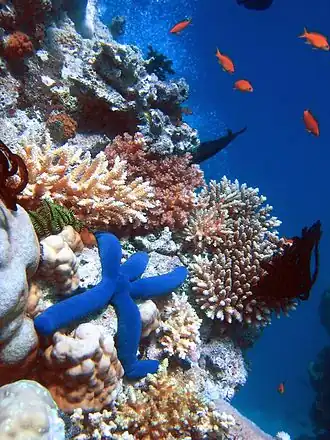
Image 19Biodiversity of a coral reef. Corals adapt and modify their environment by forming calcium carbonate skeletons. This provides growing conditions for future generations and forms a habitat for many other species. (from Environmental science)
Image 29Loch Lomond in Scotland forms a relatively isolated ecosystem. The fish community of this lake has remained stable over a long period until a number of introductions in the 1970s restructured its food web. (from Ecosystem)
Image 31The leaves of an Alnus nepalensis tree provide a microhabitat for species like the leaf beetle Aulacophora indica. (from Habitat)
Image 32Terrestrial Ecoregions of the World (Olson et al. 2001, BioScience) (from Ecoregion)
Image 33Few creatures make the ice shelves of Antarctica their habitat, but water beneath the ice can provide habitat for multiple species. Animals such as penguins have adapted to live in very cold conditions. (from Habitat)
Image 35A false color composite of the greater Boston area, created using remote sensing technology, reveals otherwise not visible characteristics about the land cover and the health of the surrounding ecosystems. (from Environmental science)
Image 38Global oceanic and terrestrial phototroph abundance, from September 1997 to August 2000. As an estimate of autotroph biomass, it is only a rough indicator of primary production potential and not an actual estimate of it. (from Ecosystem)
Image 47A team of British researchers found a hole in the ozone layer forming over Antarctica, the discovery of which would later influence the Montreal Protocol in 1987. (from Environmental science)
Image 50Environmental science examines the effects of humans on nature, such as the Glen Canyon Dam in the United States (from Environmental science)
Image 51Cattails indicate the presence of phosphorus in the water. Cattails are an invasive species; they crowd out sawgrass and grow too thick to allow nesting for birds and alligators. (from Restoration of the Everglades)
Image 55Proportion of forest area by forest area density class and global ecological zone, 2015, from Food and Agriculture Organization publication The State of the World's Forests 2020. Forests, biodiversity and people – In brief (from Ecoregion)
... that rivers have been classified by many criteria, including their topography, their biotic status and their relevance to white water rafting and canoeing activities?
... that Summer Rayne Oakes has been called "the world's first eco-model" because she only models clothes made from organic or recycled materials?
Agriculture •
Climate change •
Disaster management •
Ecology •
Energy •
Energy development •
Environment •
Forestry •
International development •
Protected areas •
Superfunds •
Systems •
Urban studies and planning • Water• Sanitation
Associated Wikimedia
The following Wikimedia Foundation sister projects provide more on this subject:


.jpg)

.jpg)


.jpg)


_peeking_from_a_leaf_hole_of_an_Alnus_nepalensis_tree_(cropped).jpg)

_18.jpg)


.JPG)


.jpg)


.jpg)


.jpg)


