Portal:Insects

The Insects Portal


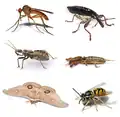
Insects (from Latin insectum) are hexapod invertebrates of the class Insecta. They are the largest group within the arthropod phylum. Insects have a chitinous exoskeleton, a three-part body (head, thorax and abdomen), three pairs of jointed legs, compound eyes, and a pair of antennae. Insects are the most diverse group of animals, with more than a million described species; they represent more than half of all animal species. (Full article...)
Selected article -

The Phasmatodea (also known as Phasmida or Phasmatoptera) are an order of insects whose members are variously known as stick insects, stick bugs, walkingsticks, stick animals, or bug sticks. They are also occasionally referred to as Devil's darning needles, although this name is shared by both dragonflies and crane flies. They can be generally referred to as phasmatodeans, phasmids, or ghost insects, with phasmids in the family Phylliidae called leaf insects, leaf-bugs, walking leaves, or bug leaves. The group's name is derived from the Ancient Greek φάσμα phasma, meaning an apparition or phantom, referring to their resemblance to vegetation while in fact being animals. Their natural camouflage makes them difficult for predators to detect; still, many species have one of several secondary lines of defense in the form of startle displays, spines or toxic secretions. Stick insects from the genera Phryganistria, Ctenomorpha, and Phobaeticus include the world's longest insects.
Members of the order are found on all continents except Antarctica, but they are most abundant in the tropics and subtropics. They are herbivorous, with many species living unobtrusively in the tree canopy. They have an incomplete metamorphosis life cycle with three stages: egg, nymph and adult. Many phasmids are parthenogenic or androgenetic, and do not require fertilized eggs for female offspring to be produced. In hotter climates, they may breed all year round; in more temperate regions, the females lay eggs in the autumn before dying, and the new generation hatches in the spring. Some species have wings and can disperse by flying, while others are more restricted. (Full article...)
Did you know -
- ... that the flower chafer species Eupoecila australasiae gains its common name of 'fiddler beetle' from its violin-shaped markings?
- ... that the larvae of the Silky Hairstreak secrete substances that attract ants?
- ... that unlike other siricid wood wasps, Xeris spectrum does not have symbiotic fungi to aid its larvae as they burrow in the wood of fir and other conifer trees?
- ... that the extinct snakefly genus Proraphidia is known from fossils found in Spain, England, and Kazakhstan?
- ... that Kricogonia lyside can grow from egg to adult in as little as 13 days?
List articles

- List of largest insects
- List of data deficient insects
- List of least concern insects
- List of near threatened insects
- List of vulnerable insects
- List of endangered insects
- List of critically endangered insects
Related portals


General images -
-
 Larva of Syrphid fly, member of Cyclorrhapha, without epicranium, almost without sclerotisation apart from its jaws. (from Insect morphology)
 -
.JPG) Mayfly nymph with paired abdominal gills (from Insect flight)
Mayfly nymph with paired abdominal gills (from Insect flight) -
 Cross-section of wing vein (from Insect morphology)
 -
 Head of Orthoptera, Acrididae. a:antenna; b:ocelli; c:vertex; d:compound eye; e:occiput; f:gena; g:pleurostoma; h:mandible; i:labial palp; j:maxillary palps; k:maxilla; l:labrum; m:clypeus; n:frons (from Insect morphology)
 -
 Insect morphology
Legend of body parts
Tagmata: A – Head, B – Thorax, C – Abdomen.(from Insect morphology)- antenna
- ocelli (lower)
- ocelli (upper)
- compound eye
- brain (cerebral ganglia)
- prothorax
- dorsal blood vessel
- tracheal tubes (trunk with spiracle)
- mesothorax
- metathorax
- forewing
- hindwing
- mid-gut (stomach)
- dorsal tube (heart)
- ovary
- hind-gut (intestine, rectum & anus)
- anus
- oviduct
- nerve cord (abdominal ganglia)
- Malpighian tubes
- tarsal pads
- claws
- tarsus
- tibia
- femur
- trochanter
- fore-gut (crop, gizzard)
- thoracic ganglion
- coxa
- salivary gland
- subesophageal ganglion
- mouthparts
-
 Mazothairos, a Carboniferous member of the now extinct order Palaeodictyoptera. (from Evolution of insects)
 -
.jpg)
-
 The female genitalia of Lepidoptera (from Insect reproductive system)
 -
 Reconstruction Strudiella devonica as a possible hexapod (from Evolution of insects)
 -
.png) Variety of male structures in Phlebotominae (Diptera, Psychodidae) (from Insect reproductive system)
Variety of male structures in Phlebotominae (Diptera, Psychodidae) (from Insect reproductive system) -
 Diagram of a typical insect leg (from Insect morphology)
 -
-
 Direct flight: muscles attached to wings. Large insects only (from Insect flight)
 -
 Larva of beetle, family Cerambycidae, showing sclerotised epicranium; rest of body hardly sclerotised (from Insect morphology)
 -
.jpg) Hoverfly (Philhelius pedissequum) has indirect flight musculature. (from Insect flight)
Hoverfly (Philhelius pedissequum) has indirect flight musculature. (from Insect flight) -
 Venation of insect wings, based on the Comstock-Needham system (from Insect morphology)
 -
 Closeup of a fire ant, showing fine sensory hairs on antennae (from Insect morphology)
 -
 Queen Alexandra's birdwing (Ornithoptera alexandrae) of Papua New Guinea (from Insect biodiversity)
 -
 A pie chart of described eukaryote species, showing just over half of these to be insects (from Insect biodiversity)
 -
 The Odonata (dragonflies and damselflies) have direct flight musculature, as do mayflies. (from Insect flight)
 -
 Male genitalia of Lepidoptera (from Insect reproductive system)
 -
 Stylized diagram of insect digestive tract showing malpighian tubule, from an insect of the order Orthoptera. (from Insect morphology)
 -
 Mandibles of Rhyniognatha hirsti, it may be an oldest insect, but also possible to be a myriapod. (from Evolution of insects)
 -
 Bumblebee defecating. Note the contraction of the anus, which provides internal pressure. (from Insect morphology)
 -
 Indian moon moth (Actias selene) with some of the spiracles identified (from Respiratory system of insects)
 -
 Generalized arthropod biramous limb. Trueman proposed that an endite and an exite fused to form a wing. (from Insect flight)
 -
 Frenulo-retinacular wing coupling in male and female moths (from Insect flight)
 -
 Evolution has produced astonishing variety of appendages in insects, such as these antennae. (from Evolution of insects)
 -
 A tau emerald (Hemicordulia tau) dragonfly has flight muscles attached directly to its wings. (from Insect flight)
 -
 Scanning electron micrograph of a cricket spiracle valve (from Respiratory system of insects)
 -
 The development of insect mouthparts from the primitive chewing mouthparts of a grasshopper in the center (A), to the lapping type (B) of a bee, the siphoning type (C) of a butterfly and the sucking type (D) of a female mosquito.
Legend: a – antennae
c – compound eye
lb – labium
lr – labrum
md – mandibles
mx – maxillae (from Insect morphology) -
 The abdominal terminus of male scorpionflies is enlarged into a "genital bulb", as seen in Panorpa communis (from Insect morphology)
Selected image -

The yellow fever mosquito, Aedes aegypti (Diptera: Culicidae), is a mosquito that can spread the dengue fever, Chikungunya and yellow fever viruses, and other diseases. It can be recognized by white markings on legs and a marking in the form of a lyre on the thorax.
Topics
| |||||||||||||||
| |||||||||||||||
| |||||||||||||||
| Aspects of insects in culture |
| ||||||||||||||
|---|---|---|---|---|---|---|---|---|---|---|---|---|---|---|---|
| Pioneers |
| ||||||||||||||
| Concerns | |||||||||||||||
| Categories, templates |
| ||||||||||||||
 | |||||||||||||||
Subcategories

WikiProjects

Main WikiProject:
- WikiProject Insects
Related projects:
- WikiProject Arthropods
- WikiProject Spiders
- WikiProject Animals
- WikiProject Tree of Life
- WikiProject Biology
Daughter projects:
- WikiProject Lepidoptera
Tasks
 |
Here are some tasks awaiting attention:
|
Associated Wikimedia
The following Wikimedia Foundation sister projects provide more on this subject:
-
 Commons
Free media repository -
 Wikibooks
Free textbooks and manuals -
 Wikidata
Free knowledge base -
 Wikinews
Free-content news -
 Wikiquote
Collection of quotations -
 Wikisource
Free-content library -
 Wikiversity
Free learning tools -
 Wiktionary
Dictionary and thesaurus
-
 List of all portals
 -

-

-

-

-

-

-

-

-

-
 Random portal
 -
 WikiProject Portals