Portal:Language


Introduction
.jpg)

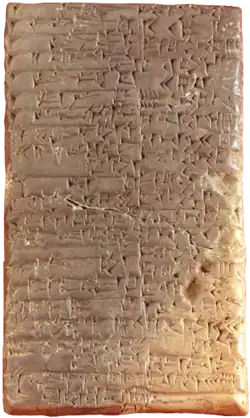

Language is a structured system of communication that consists of grammar and vocabulary. It is the primary means by which humans convey meaning, both in spoken and signed forms, and may also be conveyed through writing. Human language is characterized by its cultural and historical diversity, with significant variations observed between cultures and across time. Human languages possess the properties of productivity and displacement, which enable the creation of an infinite number of sentences, and the ability to refer to objects, events, and ideas that are not immediately present in the discourse. The use of human language relies on social convention and is acquired through learning.
Estimates of the number of human languages in the world vary between 5,000 and 7,000. Precise estimates depend on an arbitrary distinction (dichotomy) established between languages and dialects. Natural languages are spoken, signed, or both; however, any language can be encoded into secondary media using auditory, visual, or tactile stimuli – for example, writing, whistling, signing, or braille. In other words, human language is modality-independent, but written or signed language is the way to inscribe or encode the natural human speech or gestures.
Depending on philosophical perspectives regarding the definition of language and meaning, when used as a general concept, "language" may refer to the cognitive ability to learn and use systems of complex communication, or to describe the set of rules that makes up these systems, or the set of utterances that can be produced from those rules. All languages rely on the process of semiosis to relate signs to particular meanings. Oral, manual and tactile languages contain a phonological system that governs how symbols are used to form sequences known as words or morphemes, and a syntactic system that governs how words and morphemes are combined to form phrases and utterances.
The scientific study of language is called linguistics. Critical examinations of languages, such as philosophy of language, the relationships between language and thought, how words represent experience, etc., have been debated at least since Gorgias and Plato in ancient Greek civilization. Thinkers such as Jean-Jacques Rousseau (1712–1778) have argued that language originated from emotions, while others like Immanuel Kant (1724–1804) have argued that languages originated from rational and logical thought. Twentieth century philosophers such as Ludwig Wittgenstein (1889–1951) argued that philosophy is really the study of language itself. Major figures in contemporary linguistics include Ferdinand de Saussure and Noam Chomsky. (Full article...)
Selected language -

The Natchez language is the ancestral language of the Natchez people who historically inhabited Mississippi and Louisiana, and who now mostly live among the Muscogee and Cherokee peoples in Oklahoma. The language is considered to be either unrelated to other indigenous languages of the Americas or distantly related to the Muskogean languages.
The phonology of Natchez is atypical in having voicing distinction in its sonorants but not in its obstruents; it also has a wide range of morphophonemic processes. Morphologically, it has complex verbal inflection and a relatively simple nominal inflection (the ergative case marks nouns in transitive clauses), and its syntax is characterized by active-stative alignment and subject-object-verb word order (or more accurately Agent-Object-Verb and Subject-Verb). Natchez storytellers used a specific register, "cannibal speech", to impersonate cannibals, a recurring character in Natchez oral literature. (Full article...)
Did you know (auto-generated)

- ... that a language riot broke out between members of Our Lady of the Rosary in 1917?
- ... that Ivan Ančić was the first Bosnian Franciscan to use the Latin script to write in his native language?
- ... that Karan Aujla's Hindi-language single "Tauba Tauba" from the 2024 film Bad Newz became a Canadian Hot 100 top-25 song ahead of the film's release?
- ... that the 1929 book The Magic Island by William Seabrook is considered the first popular English-language work to describe a zombie?
- ... that Dorothy Stanley was once said to be one of the last speakers of the Miwok languages?
- ... that the Lviv branch of the Ukrderzhnatsmenvydav was the main publisher of Polish literature in the Soviet Union by 1941?
More did you know -
- ...that Bambaiya Hindi, a pidgin used in Mumbai, is a combination of English, Marathi, Gujarati and several other languages?
- ...that famous epic poems like Beowulf and Judith were written in Late West Saxon?
- ...that the Inuktun language, spoken by 1000 Inughuit people around Qaanaaq in northern Greenland, is related to Canadian Inuit languages?
- ...that most Russian-speakers in the United States are Jewish immigrants from the former Soviet Union?
Categories
Linguistics: Computational linguistics • Grammar • Historical linguistics • Morphology • Phonetics • Phonology • Pragmatics • Reading • Semantics • Sociolinguistics • Syntax • Writing
Languages: Language families • Pidgins and creoles • Sign languages
Linguists: By nationality • Historical linguists • Morphologists • Phoneticians • Phonologists • Sociolinguists • Syntacticians • Translators
Stubs: Constructed languages • Languages • Linguists • Pidgins and creoles • Typography • Vocabulary and usage • Writing systems
Full Language category tree
|
|---|
|
Select [►] to view subcategories
Language Languages Outlines of languages Language acquisition Language-related awards Language comparison Language competitions Natural language and computing Fiction about language Language games Gender in language Language identifiers Language interpretation Language mechanics Language reform Linguistics Language movements Language and mysticism Oral communication Personifications of languages Philology Philosophy of language Language policy Self-reference Sign language Sociology of language Language software Speech Speech and language pathology Speech surrogacy Statements Terminology Vocabulary Works about language Writing Language stubs |
Related portals


Selected topic -

The Russian language is spoken natively by a considerable proportion of the population of Israel, mostly by immigrants who came from the former Soviet Union from 1989 onwards. It is a major foreign language in the country, and is used in many aspects of life. Russian is the third most common native language in Israel after Modern Hebrew and Arabic. Government institutions and businesses often also provide information and services in Russian, and has effectively become semi-official in some areas with high concentration of Russian-speaking immigrants. The Russian-speaking population of Israel is the world's third-largest population of Russian native-speakers living outside the former Soviet Union territories after Germany and the United States, and the highest as a proportion of the population. As of 2013, 1,231,003 residents of the Post-Soviet states have immigrated to Israel since the fall of the Soviet Union. As of 2017, there are up to 1.5 million Russian-speaking Israelis out of total population of 8,700,000 (17.25%). (Full article...)
Selected picture -

The Rosetta Stone is an ancient Egyptian granodiorite stele inscribed with a decree issued at Memphis in 196 BC on behalf of King Ptolemy V. The decree appears in three scripts: the upper text is Ancient Egyptian hieroglyphs, the middle portion Demotic script, and the lowest Ancient Greek.
Language News
- 13 June 2025 – Middle Eastern crisis
- Exiled crown prince Reza Pahlavi, the son of Iran's last Shah, writes in Farsi calling for the Iranian military to abandon the Islamic Republic and accuses Supreme Leader Ayatollah Ali Khamenei of forcing Iranians into the war. He also refers to the war as "Khamenei's war and the Islamic Republic's war". (Jerusalem Post)
- 1 March 2025 – Executive orders in the second presidency of Donald Trump
- United States President Donald Trump signs an executive order designating English as the country's official language. (The Guardian)
- 27 February 2025 –
- OpenAI releases their latest large language model, GPT-4.5. (The Verge)
Topics

Languages of Africa: Arabic, Chadic, Cushitic, Kanuri, Maasai, Setswana, Swahili, Turkana, Xhosa, Yoruba, Zulu, more...
Languages of the Americas: Aleut, Carib, Cherokee, Inuktitut, Iroquois, Kootenai, Mayan, Nahuatl, Navajo, Quechuan, Salish, American Sign Language, more...
Languages of Asia: Arabic, Assamese, Balochi, Bengali, Chinese, Japanese, Hajong, Hebrew, Hindustani, Kannada, Kokborok, Marathi, Khasi, Korean, Kurdish, Malayalam, Manipuri, Meithei, Mongolian, Persian, Rajasthani, Sindhi, Sanskrit, Sylheti, Tamil, Tanchangya, Tulu, Telugu, Tibetan, Thai, Turkish, Vietnamese, Khowar, more...
Languages of Austronesia: Austric, Fijian, Hawaiian, Javanese, Malagasy, Malay, Maori, Marshallese, Samoan, Tahitian, Tagalog, Tongan, Auslan, more...
Languages of Europe: Basque, Czech, Danish, Dutch, English (book), French, German, Greek, Italian, Latin, Leonese, Norwegian, Polish, Portuguese, Romanian, Russian, Slovak, Spanish, Ukrainian more...
Constructed languages: Esperanto, Ido, Volapük, more...
Agglutinative language, Analytic language, Constructed language, Creole, Context-free language, Extinct language, Dialect, Fusional language, Inflectional language, International language, Isolating language, Language isolate, National language, Natural language, Pidgin, Pluricentric language, Polysynthetic language, Proto-language, Sign language, Spoken language, Synthetic language, Variety (linguistics)

Applied linguistics, Cognitive linguistics, Accent (dialect), Computational linguistics, Descriptive linguistics, Eurolinguistics, Generative linguistics, Historical linguistics, Lexicology, Lexical semantics, Morphology, Onomasiology, Phonetics, Phonology, Pragmatics, Prescription, Prototype semantics, Psycholinguistics, Semantics, Stylistics, Sociolinguistics, Syntax
See also: List of linguists

Alphabets: Arabic alphabet, Bengali alphabet, Cyrillic alphabet, Hebrew alphabet, Latin alphabet, more...
Other writing systems: Abjad, Abugida, Braille, Hieroglyphics, Logogram, Syllabary, SignWriting, more..
See also: History of the alphabet, Script
Associated Wikimedia
The following Wikimedia Foundation sister projects provide more on this subject:
-
 Commons
Free media repository -
 Wikibooks
Free textbooks and manuals -
 Wikidata
Free knowledge base -
 Wikinews
Free-content news -
 Wikiquote
Collection of quotations -
 Wikisource
Free-content library -
 Wikiversity
Free learning tools -
 Wiktionary
Dictionary and thesaurus
Find a language
| Enter an ISO 639 code to find the corresponding language article |
-
 List of all portals
 -

-

-

-

-

-

-

-

-

-
 Random portal
 -
 WikiProject Portals