Portal:Solar System

The Solar System Portal

The Solar System consists of the Sun and the objects that orbit it. The name comes from Sōl, the Latin name for the Sun. It formed about 4.6 billion years ago when a dense region of a molecular cloud collapsed, creating the Sun and a protoplanetary disc from which the orbiting bodies assembled. The fusion of hydrogen into helium inside the Sun's core releases energy, which is primarily emitted through its outer photosphere. This creates a decreasing temperature gradient across the system. Over 99.86% of the Solar System's mass is located within the Sun.
The most massive objects that orbit the Sun are the eight planets. Closest to the Sun in order of increasing distance are the four terrestrial planets – Mercury, Venus, Earth and Mars. Only the Earth and Mars orbit within the Sun's habitable zone, where liquid water can exist on the surface. Beyond the frost line at about five astronomical units (AU), are two gas giants – Jupiter and Saturn – and two ice giants – Uranus and Neptune. Jupiter and Saturn possess nearly 90% of the non-stellar mass of the Solar System.
There are a vast number of less massive objects. There is a strong consensus among astronomers that the Solar System has at least nine dwarf planets: Ceres, Orcus, Pluto, Haumea, Quaoar, Makemake, Gonggong, Eris, and Sedna. Six planets, seven dwarf planets, and other bodies have orbiting natural satellites, which are commonly called 'moons', and range from sizes of dwarf planets, like Earth's Moon, to moonlets. There are small Solar System bodies, such as asteroids, comets, centaurs, meteoroids, and interplanetary dust clouds. Some of these bodies are in the asteroid belt (between Mars's and Jupiter's orbit) and the Kuiper belt (just outside Neptune's orbit).
Between the bodies of the Solar System is an interplanetary medium of dust and particles. The Solar System is constantly flooded by outflowing charged particles from the solar wind, forming the heliosphere. At around 70–90 AU from the Sun, the solar wind is halted by the interstellar medium, resulting in the heliopause. This is the boundary to interstellar space. The Solar System extends beyond this boundary with its outermost region, the theorized Oort cloud, the source for long-period comets, extending to a radius of 2,000–200,000 AU. The Solar System currently moves through a cloud of interstellar medium called the Local Cloud. The closest star to the Solar System, Proxima Centauri, is 4.25 light-years (269,000 AU) away. Both are within the Local Bubble, a relatively small 1,000 light-years wide region of the Milky Way. (Full article...)
Selected article –
_(cropped).jpg)
Selected picture
-


Earthrise, as seen by Apollo 8 Credit: William AndersEarthrise, the first occasion in which humans saw the Earth seemingly rising above the surface of the Moon, taken during the Apollo 8 mission on December 24, 1968. This view was seen by the crew at the beginning of its fourth orbit around the Moon, although the first photograph taken was in black-and-white. Note that the Earth is in shadow here. A photo of a fully lit Earth would not be taken until the Apollo 17 mission. -
 Saturn's moon Mimas, as imaged by the Cassini spacecraft. It was discovered on 17 September 1789 by English astronomer William Herschel, and was named after Mimas, a son of Gaia in Greek mythology, by Herschel's son John. The large Herschel Crater is the dominating feature of the moon. With a diameter of 396 km (246 mi), it is the smallest astronomical body that is known to be rounded due to self-gravitation.
 -
 Diagram: Kelvin SongA diagram of Jupiter showing a model of the planet's interior, with a rocky core overlaid by a deep layer of liquid metallic hydrogen and an outer layer predominantly of molecular hydrogen. Jupiter's true interior composition is uncertain. For instance, the core may have shrunk as convection currents of hot liquid metallic hydrogen mixed with the molten core and carried its contents to higher levels in the planetary interior. Furthermore, there is no clear physical boundary between the hydrogen layers—with increasing depth the gas increases smoothly in temperature and density, ultimately becoming liquid.
 -
These images are composites of the complete radar image collection obtained by the Magellan mission. The Magellan spacecraft was launched aboard Space Shuttle Atlantis in May 1989 and began mapping the surface of Venus in September 1990. The spacecraft continued to orbit Venus for four years, returning high-resolution images, altimetry, thermal emissions and gravity maps of 98 percent of the surface. Magellan spacecraft operations ended on October 12, 1994, when the radio contact was lost with the spacecraft during its controlled descent into the deeper portions of the Venusian atmosphere.
-
 Model: NickshanksLunar distance is a measurement of the distance from the Earth to the Moon. This diagram shows the distance, averaging 384,400 km (238,900 mi), to scale, as well as the Earth and the Moon (scroll to see the entire image).
 -

Jupiter Credit: Cassini probeJupiter is the fifth planet from the Sun and by far the largest within the Solar System. It is 318 times more massive than Earth, with a diameter 11 times that of Earth, and with a volume 1300 times that of Earth. Its best known feature is the Great Red Spot, a storm larger than Earth, which was first observed by Galileo four centuries ago. This picture, taken by the Cassini orbiter was one of 26 thousand images taken of Jupiter during the course of its flyby and is the most detailed global color portrait of the planet ever produced. -
Mars, the fourth planet from the Sun, is named after the Roman god of war because of its blood red color. Mars has two small, oddly-shaped moons, Phobos and Deimos, named after the sons of the Greek god Ares. At some point in the future Phobos will be broken up by gravitational forces. The atmosphere on Mars is 95% carbon dioxide. In 2003 methane was also discovered in the atmosphere. Since methane is an unstable gas, this indicates that there must be (or have been within the last few hundred years) a source of the gas on the planet.
-

Comet Hale-Bopp 29-03-1997 Credit: Philipp SalzgeberComet Hale–Bopp sails across the sky in the vicinity of Pazin in Istria, Croatia. To the lower right of the comet the Andromeda Galaxy is also faintly visible. The comet was visible to the naked eye for a record 18 months, twice as long as the Great Comet of 1811. At perihelion, it shone brighter than any star in the sky except Sirius, and its two tails stretched 30-40 degrees across the sky. The passage of Hale-Bopp was notable also for inciting a degree of panic about comets not seen for decades. Rumours that the comet was being followed by an alien spacecraft inspired a mass suicide among followers of the Heaven's Gate cult. -
A TRACE image of sunspots on the surface, or photosphere, of the Sun from September 2002, is taken in the far ultraviolet on a relatively quiet day for solar activity. However, the image still shows a large sunspot group visible as a bright area near the horizon. Although sunspots are relatively cool regions on the surface of the Sun, the bright glowing gas flowing around the sunspots have a temperature of over one million °C (1.8 million °F). The high temperatures are thought to be related to the rapidly changing magnetic field loops that channel solar plasma.
-
 Photo credit: Cassini orbiterSaturn eclipsing the Sun, as seen by the Cassini orbiter. Individual rings seen in this image include (in order, starting from most distant): E ring, Pallene ring (visible very faintly in an arc just below Saturn), G ring, Janus/Epimetheus ring (faint), F ring (narrow brightest feature), Main rings (A,B,C), and D ring (bluish, nearest Saturn). Interior to the G ring and above the brighter main rings is the pale dot of Earth.
 -
 Photo credit: The Apollo 17 crewThe Blue Marble is a famous photograph of Earth. NASA officially credits the image to the entire Apollo 17 crew — Eugene Cernan, Ronald Evans and Jack Schmitt — all of whom took photographic images during the mission. Apollo 17 passed over Africa during daylight hours and Antarctica is also illuminated. The photograph was taken approximately five hours after the spacecraft's launch, while en route to the Moon. Apollo 17, notably, was the last manned lunar mission; no humans since have been at a range where taking a "whole-Earth" photograph such as "The Blue Marble" would be possible.
 -
.gif) Image: Tom RuenAn animation of the phases of the Moon. As the Moon revolves around the Earth, the Sun lights the Moon from a different side, creating the different phases. In the image, the Moon appears to get bigger as well as "wobble" slightly. Tidal locking synchronizes the Moon's rotation period on its axis to match its orbital period around the earth. These two periods nearly cancel each other out, except that the Moon's orbit is elliptical. This causes its orbital motion to speed up when closer to the Earth, and slow down when farther away, causing the Moon's apparent diameter to change, as well as the wobbling motion observed.
Image: Tom RuenAn animation of the phases of the Moon. As the Moon revolves around the Earth, the Sun lights the Moon from a different side, creating the different phases. In the image, the Moon appears to get bigger as well as "wobble" slightly. Tidal locking synchronizes the Moon's rotation period on its axis to match its orbital period around the earth. These two periods nearly cancel each other out, except that the Moon's orbit is elliptical. This causes its orbital motion to speed up when closer to the Earth, and slow down when farther away, causing the Moon's apparent diameter to change, as well as the wobbling motion observed. -
 Image credit: Cassini orbiterThe most detailed full-disc view of Titan, the largest moon of Saturn and second-largest in the Solar System. The brighter region on the right side and equatorial region is named Xanadu, and the large, dark region at the center is Shangri-la. This image has been processed to reduce the effects of the atmosphere and to sharpen surface features. It has been trimmed to show only the illuminated surface and not the atmosphere above the edge of the moon.
 -
 Photograph credit: European Space AgencyMars is the fourth planet from the Sun and is known as the "Red Planet" due to its reddish appearance as seen from Earth. The planet is named after Mars, the Roman god of war. A terrestrial planet, Mars has a thin atmosphere and surface features reminiscent both of the impact craters of the Moon and the volcanoes, valleys, deserts and polar ice caps of the Earth. The planet has the highest mountain in the Solar System, Olympus Mons, as well as the largest canyon, Valles Marineris. Mars's rotation period and seasonal cycles are also similar to those of the Earth. Of all the planets in the Solar System other than Earth, Mars is the most likely to harbour liquid water and perhaps life. There are ongoing investigations assessing Mars's past potential for habitability, as well as the possibility of extant life. Future astrobiology missions are planned, including NASA's Mars 2020 rover and the European Space Agency (ESA)'s Rosalind Franklin rover. In November 2016, NASA reported finding a large amount of underground ice in the Utopia Planitia region of the planet. The volume of water detected has been estimated to be equivalent to the volume of water in Lake Superior. Mars has two moons, Phobos and Deimos, which are small and irregularly shaped.
This picture is a true-colour image of Mars, taken from a distance of about 240,000 kilometres (150,000 mi) by the OSIRIS instrument on ESA's Rosetta spacecraft, during its February 2007 flyby of the planet. The image was generated using OSIRIS's orange (red), green and blue filters. -
 Photo credit: Luc ViatourFull moon is a lunar phase that occurs when the Moon is on the opposite side of the Earth from the Sun, and when the three celestial bodies are aligned as closely as possible to a straight line. At this time, as seen by viewers on Earth, the hemisphere of the Moon that is facing the Earth (the near side) is fully illuminated by sunlight and appears round. Only during a full moon is the opposite hemisphere of the Moon, which is not visible from Earth (the far side), completely unilluminated.
 -
 An animated view of Voyager I's approach to Jupiter. One frame of this image was taken each Jupiter day (approximately 10 hours) between January 6 and February 9, 1979, as the space probe flew from 58 million to 31 million kilometers from Jupiter during that time. The small, round, dark spots appearing in some frames are the shadows cast by the moons passing between Jupiter and the Sun, while the small, white flashes around the planet, are the moons themselves.
 -
 Photo credit: Cassini orbiterHyperion, a moon of Saturn, is one of the largest highly irregular (non-spherical) bodies in the Solar System. Enhanced image processing was used to bring out details and color differences in this photo taken by the Cassini orbiter. Hyperion is entirely saturated with deep, sharp-edged craters that give it the appearance of a giant sponge. Dark material fills the bottom of each crater.
 -

Solar eclipse of 11 August 1999 Credit: Luc ViatourThe solar eclipse of 1999 August 11, as seen from France. This was the most viewed total eclipse in human history, although some areas offered impaired visibility due to adverse weather conditions. The path of the Moon's shadow began in the Atlantic Ocean, before traversing Cornwall, northern France, southern Germany, Austria, Hungary and northern Serbia. Its maximum was in Romania, and it continued across the Black Sea, Turkey, Iran, southern Pakistan and India. -
 Photo credit: Cassini orbiterThis polar map of Jupiter, taken by the Cassini orbiter as it neared Jupiter during a flyby on its way to Saturn, is the most detailed global color map of the planet ever produced. The south pole is in the center of the map and the equator is at the edge. The map shows a variety of colorful cloud features, including parallel reddish-brown and white bands, the Great Red Spot, multi-lobed chaotic regions, white ovals, and many small vortexes. Many clouds appear in streaks and waves due to continual stretching and folding by Jupiter's winds and turbulence.
 -
 Photo credit: Voyager 1False-color detail of Jupiter's atmosphere, imaged by Voyager 1, showing the Great Red Spot and a passing white oval. The wavy cloud pattern to the left of the Red Spot is a region of extraordinarily complex and variable wave motion. To give a sense of Jupiter's scale, the white oval storm directly below the Great Red Spot is approximately the same diameter as Earth.
 -
 Diagram credit: Kelvin MaThe Sun is the star at the center of the Solar System. It is a nearly perfect sphere of hot plasma, heated to incandescence by nuclear-fusion reactions in its core, radiating the energy mainly as visible light and infrared radiation. It is by far the most important source of energy for life on Earth. Its diameter is about 1.39 million kilometres (860,000 mi), or 109 times that of Earth. Its mass is about 330,000 times that of Earth, and accounts for about 99.86 percent of the total mass of the Solar System. Roughly three-quarters of the Sun's mass consists of hydrogen; the rest is mostly helium, with much smaller quantities of heavier elements, including oxygen, carbon, neon, and iron. This diagram illustrates the general structure of the Sun, with all features drawn to scale.
 -
 A black-and-white photographic mosaic depicting the comet 67P/Churyumov–Gerasimenko, as photographed by the probe Rosetta. This Jupiter-family comet, which was originally from the Kuiper belt, is about 4.3 km (2.7 mi) across, has a current orbital period of 6.45 years, a rotation period of approximately 12.4 hours, and a maximum velocity of 135,000 km/h (38 km/s; 84,000 mph). It was first observed on photographic plates in 1969 by Soviet astronomers Klim Churyumov and Svetlana Gerasimenko, after whom it is named.
 -
 Photograph credit: Neil ArmstrongTranquility Base is the landing site of the Apollo 11 mission on the Moon where, on July 20, 1969, humans first landed and walked on a celestial body other than the Earth. This photograph was taken at Tranquility Base by Neil Armstrong, the Apollo 11 commander, and depicts crewmember Buzz Aldrin with scientific equipment he had just deployed on the lunar surface. In the background on the right of the image is the lunar module, Eagle; the United States flag planted at the site during the mission was blown over the next day by the exhaust of the ascent rocket.


General images
The following are images from various Solar System-related articles on Wikipedia.
-
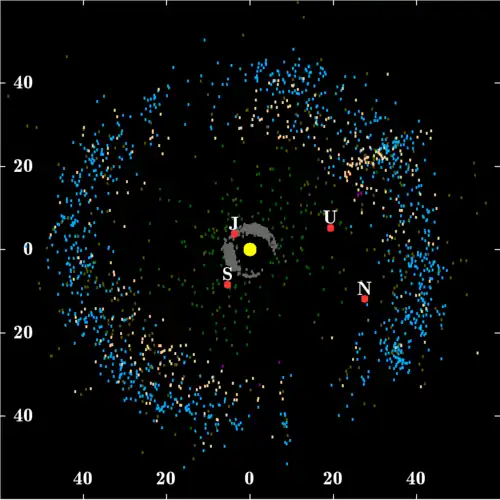 Plot of objects around the Kuiper belt and other asteroid populations. J, S, U and N denotes Jupiter, Saturn, Uranus and Neptune. (from Solar System)
 -
 An artist's impression of the Oort cloud, a region still well within the sphere of influence of the Solar System, including a depiction of the much further inside Kuiper belt (inset); the sizes of objects are over-scaled for visibility. (from Solar System)
 -
 The four largest asteroids: Ceres, Vesta, Pallas, Hygiea. Only Ceres and Vesta have been visited by a spacecraft and thus have a detailed picture. (from Solar System)
 -
 Animations of the Solar System's inner planets orbiting. Each frame represents 2 days of motion. (from Solar System)
 -
.jpg) The planets, zodiacal light and meteor shower (top left of image) (from Solar System)
The planets, zodiacal light and meteor shower (top left of image) (from Solar System) -
 Relative size of the Sun as it is now (inset) compared to its estimated future size as a red giant (from Formation and evolution of the Solar System)
 -
 Overview of the inner Solar System up to Jupiter's orbit (from Solar System)
 -
 The orbital eccentricities and inclinations of the scattered disc population compared to the classical and resonant Kuiper belt objects (from Solar System)
 -
 The motion of 'lights' moving across the sky is the basis of the classical definition of planets: wandering stars. (from Solar System)
 -
 The Sun in true white color (from Solar System)
 -
 The Ring Nebula, a planetary nebula similar to what the Sun will become (from Formation and evolution of the Solar System)
 -
 Orbit classification of Kuiper belt objects. Some clusters that is subjected to orbital resonance are marked. (from Solar System)
 -
 Simulation showing outer planets and Kuiper belt:
a) Before Jupiter/Saturn 2:1 resonance
b) Scattering of Kuiper belt objects into the Solar System after the orbital shift of Neptune
c) After ejection of Kuiper belt bodies by JupiterOrbit of JupiterOrbit of SaturnOrbit of UranusOrbit of Neptune(from Formation and evolution of the Solar System) -
.jpg) The outer planets Jupiter, Saturn, Uranus and Neptune, compared to the inner planets Earth, Venus, Mars, and Mercury at the bottom right (from Solar System)
The outer planets Jupiter, Saturn, Uranus and Neptune, compared to the inner planets Earth, Venus, Mars, and Mercury at the bottom right (from Solar System) -
 Relative orbital distances in the Solar System visualized as a condensed rectangle (from Solar System)
 -
 Animations of the Solar System's outer planets orbiting. This animation is 100 times faster than the inner planet animation. (from Solar System)
 -
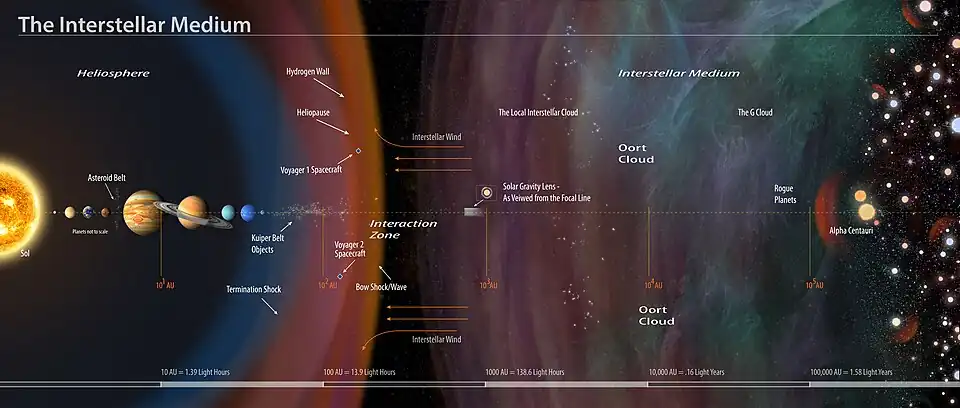 The Solar System (left) within the interstellar medium, with the different regions and their distances on a logarithmic scale (from Solar System)
 -
 Diagram of the Local Interstellar Cloud, the G-Cloud and surrounding stars. As of 2022, the exact position of the Solar System within the interstellar clouds remains an unresolved question in astronomy. (from Solar System)
 -
 Diagram of the Milky Way, with galactic features and the relative position of the Solar System labeled. (from Solar System)
 -
 Comparison of the distances between planets, with the white bar showing orbital variations. The size of the planets is not to scale. (from Solar System)
 -
 Pierre-Simon Laplace, one of the originators of the nebular hypothesis (from Formation and evolution of the Solar System)
 -
 A color enhanced photopgraph from the Moon of a range of components of the Solar System. From right to left: the Moon, lit by earthshine, the Sun's corona rising over the Moon's dark limb, and continuing from the right the planets Saturn, Mars, and Mercury (the three dots at lower left). (from Solar System)
 -
 The sparse plasma (blue) and dust (white) in the tail of comet Hale–Bopp are being shaped by pressure from solar radiation and the solar wind, respectively.
 -
.jpg) Solar system diagram by Emanuel Bowen in 1747, when neither Uranus, Neptune, nor the asteroid belts had yet been discovered. Orbits of planets are to scale, but the orbits of moons and the sizes of bodies are not. (from Solar System)
Solar system diagram by Emanuel Bowen in 1747, when neither Uranus, Neptune, nor the asteroid belts had yet been discovered. Orbits of planets are to scale, but the orbits of moons and the sizes of bodies are not. (from Solar System) -
 Artist's conception of the giant impact thought to have formed the Moon (from Formation and evolution of the Solar System)
 -
 Diagram of the early Solar System's protoplanetary disk, out of which Earth and other Solar System bodies formed (from Solar System)
 -
 Artist's conception of a protoplanetary disk (from Formation and evolution of the Solar System)
 -
 The current orbits of Sedna, 2012 VP113, Leleākūhonua (pink), and other very distant objects (red, brown and cyan) along with the predicted orbit of the hypothetical Planet Nine (dark blue) (from Solar System)
 -
 Hubble image of protoplanetary discs in the Orion Nebula, a stellar nursery approximately 25 ly across and estimated to be similar to the primordial nebula from which the Sun formed (from Formation and evolution of the Solar System)
 -
 Neptune and its moon Triton, taken by Voyager 2. Triton's orbit will eventually take it within Neptune's Roche limit, tearing it apart and possibly forming a new ring system. (from Formation and evolution of the Solar System)
 -
 Location of the Solar System within the Milky Way (from Formation and evolution of the Solar System)
 -
 Diagram of the Sun's magnetosphere and helioshealth (from Solar System)
 -
The current Sun compared to its peak size in the red-giant phase (from Solar System)
-

-
 Meteor Crater in Arizona. Created 50,000 years ago by an impactor about 50 metres (160 ft) across, it shows that the accretion of the Solar System is not over. (from Formation and evolution of the Solar System)
Did you know –
- ... that Jupiter is the only planet capable of pulling an interstellar comet into a Sun-centered orbit?
- ...that the Solar Sentinels, a NASA spacecraft designed to study the Sun, will have to survive at distances from the Sun only one-quarter of Earth's distance?
- ...that just over 50 kilometres above its surface, the atmosphere of Venus has very similar pressure and temperature as does Earth, making it the most Earth-like area in the Solar System?
- ...that NASA conducts field trials, called Desert RATS, for new technologies for manned exploration of the surface of the Moon, Mars, or beyond?
- ...that scarps, ridges, and troughs, such as the 650 km long and 2 km high Discovery Rupes cutting through the Rameau crater, are common features in the Discovery quadrangle on the planet Mercury?
- ...that the Kármán line dividing the Earth's atmosphere and outer space is defined by the Fédération Aéronautique Internationale as 100 km above mean sea level?
- ...that Mars' south polar ice cap may be melting due to global warming?
- ...that Lowell Observatory staff resisted building the telescope used to discover the dwarf planet Pluto until trustee Roger Putnam ordered them to do so?
Categories

|
||
| Solar System | ||
|---|---|---|

|
|

|
| Celestial mechanics | Comets | ...in fiction |

|

|

|
| Minor planets | Moons | Planetary missions |

|

|
.jpg)
|
| Planets... | Sun | Surface feature nomenclature... |

In the news

- April 7: NASA's helicopter Ingenuity survives its first night at Mars
- December 25: 'Earth-based life can survive in hydrogen-rich atmospheres': MIT professor Dr Seager tells Wikinews about her research on organisms thriving in oxygen-less environment
- July 7: Astronomer Anthony Boccaletti discusses observation of birth of potential exoplanet with Wikinews
- May 31: SpaceX successfully launches its first crewed spaceflight
- May 22: Astronomer tells Wikinews about discovery of closest black hole known so far
- October 12: Cosmonaut Alexei Leonov dies at age 85
- October 10: Swedish academy announces 2019 Nobel Prize winners in physics
- September 14: Astronomers find water vapour in atmosphere of exoplanet K2-18b
- March 5: SpaceX Crew Dragon capsule docks with International Space Station
- January 9: Simple animals could live in Martian brines: Wikinews interviews planetary scientist Vlada Stamenković
- November 29: NASA's InSight Lander makes it to Mars
- October 12: Manned Soyuz space mission aborts during launch
Major topics

Solar System: Planets (Definition · Planetary habitability · Terrestrial planets · Gas giants · Rings) · Dwarf planets (Plutoid) · Colonization · Discovery timelineˑ Exploration · Moons · Planetariums
- Sun: Sunspot · Solar wind · Solar flare · Solar eclipse
- Mercury: Geology · Exploration (Mariner 10 · MESSENGER · BepiColombo) · Transit
- Venus: Geology · Atmosphere · Exploration (Venera · Mariner program 2/5/10 · Pioneer · Vega 1/2ˑ Magellan · Venus Express) · Transit
- Earth: History · Geology · Geography · Atmosphere · Rotation
- Moon: Geology · Selenography · Atmosphere · Exploration (Luna · Apollo 8/11) · Orbit · Lunar eclipse
- Mars: Moons (Phobos · Deimos) · Geology · Geography · Atmosphere · Exploration (Mariner · Mars · Viking 1/2 · Pathfinder · MER)
- Ceres: Exploration (Dawn)
- Jupiter: Moons (Amalthea, Io · Europa · Ganymede · Callisto) · Rings · Atmosphere · Magnetosphere · Exploration (Pioneer 10/11 · Voyager 1/2 · Ulysses · Cassini · Galileo · New Horizons)
- Saturn: Moons (Mimas · Enceladus · Tethys · Dione · Rhea · Titan · Iapetus) · Rings · Exploration (Pioneer 11 · Voyager 1/2 · Cassini–Huygens)
- Uranus: Moons (Miranda · Ariel · Umbriel · Titania · Oberon) · Rings · Exploration (Voyager 2)
- Neptune: Moons (Triton) · Rings · Exploration (Voyager 2)
- Planets beyond Neptune
- Pluto: Moons (Charon, Nix, Hydra, Kerberos, Styx) · Geology · Atmosphere · Exploration (New Horizons)
- Haumea: Moons (Hi'iaka, Namaka) · Ring
- Quaoar: Weywot · Rings
- Makemake: S/2015 (136472) 1
- Gonggong: Xiangliu
- Eris: Dysnomia
- Sedna
- Small bodies: Meteoroids · Asteroids (Asteroid belt) · Centaurs · TNOs (Kuiper belt · Scattered disc · Oort cloud) · Comets (Hale–Bopp · Halley's · Hyakutake · Shoemaker–Levy 9)
- Formation and evolution of the Solar System: History of Solar System formation and evolution hypotheses · Nebular hypothesis
- See also: Featured content · Featured topic · Good articles · List of objects
Bold articles are featured.
Italicized articles are on dwarf planets or major moons.
Things you can do
 |
Here are some tasks awaiting attention:
|
Related portals


Related WikiProjects

|

|

|
| Solar System | Moon | Mars |
|---|---|---|

|

|

|
| Astronomy | Astronomical objects | Spaceflight |
Associated Wikimedia
The following Wikimedia Foundation sister projects provide more on this subject:
-
 Commons
Free media repository -
 Wikibooks
Free textbooks and manuals -
 Wikidata
Free knowledge base -
Wikinews
Free-content news -
 Wikiquote
Collection of quotations -
 Wikisource
Free-content library -
 Wikiversity
Free learning tools -
 Wiktionary
Dictionary and thesaurus
-
 List of all portals
 -

-

-

-

-

-

-

-

-

-
 Random portal
 -
 WikiProject Portals