This article has multiple issues. Please help improve it or discuss these issues on the talk page. (Learn how and when to remove these messages)
This article does not cite any sources. Please help improve this article by adding citations to reliable sources. Unsourced material may be challenged and removed. Find sources:"Sankt Goar line" – news·newspapers·books·scholar·JSTOR(December 2009) (Learn how and when to remove this message)
An editor has determined that sufficient sources exist to establish the subject's notability. Please help improve this article by adding citations to reliable sources. Unsourced material may be challenged and removed. Find sources:"Sankt Goar line" – news·newspapers·books·scholar·JSTOR(November 2024) (Learn how and when to remove this message)
(Learn how and when to remove this message)
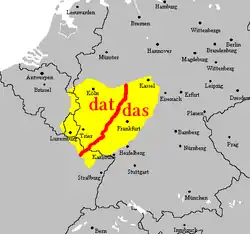
The Sankt Goar line.
In Germanlinguistics, the Sankt Goar line, das–dat line, or was–wat line is an isogloss separating the dialects to the north, which have a t in the words dat (English that) and wat (English what), from the dialects to the south (including standard German), which have an s: das, was. The line runs from North-East to South-West and crosses the river Rhine at the town of Sankt Goar.