Portal:Computer programming

The Computer Programming Portal
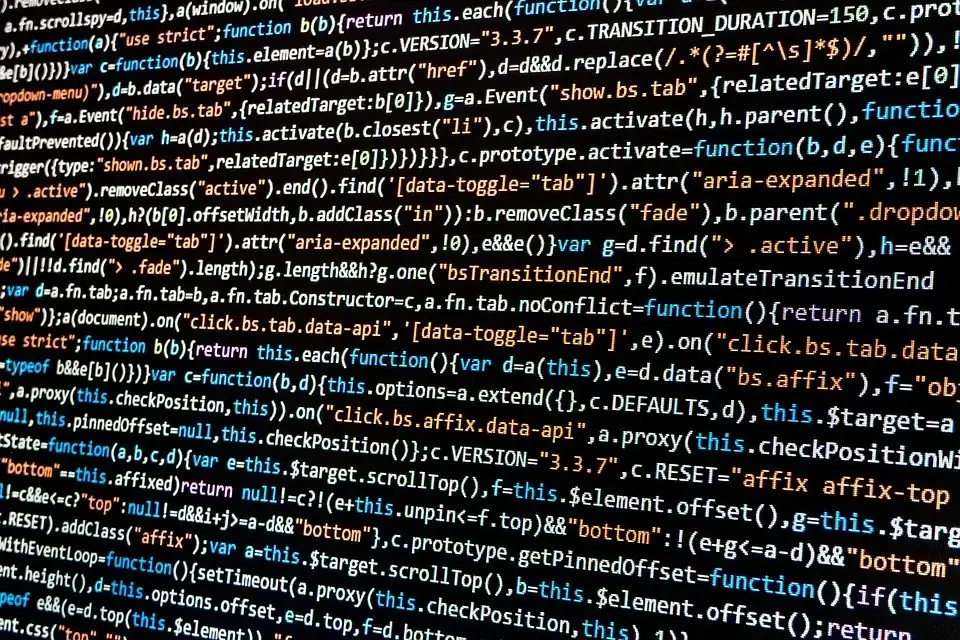
Computer programming or coding is the composition of sequences of instructions, called programs, that computers can follow to perform tasks. It involves designing and implementing algorithms, step-by-step specifications of procedures, by writing code in one or more programming languages. Programmers typically use high-level programming languages that are more easily intelligible to humans than machine code, which is directly executed by the central processing unit. Proficient programming usually requires expertise in several different subjects, including knowledge of the application domain, details of programming languages and generic code libraries, specialized algorithms, and formal logic.
Auxiliary tasks accompanying and related to programming include analyzing requirements, testing, debugging (investigating and fixing problems), implementation of build systems, and management of derived artifacts, such as programs' machine code. While these are sometimes considered programming, often the term software development is used for this larger overall process – with the terms programming, implementation, and coding reserved for the writing and editing of code per se. Sometimes software development is known as software engineering, especially when it employs formal methods or follows an engineering design process. (Full article...)
Selected articles -
-
 Ronald Paul "Ron" Fedkiw (born February 27, 1968) is a full professor in the Stanford University department of computer science and a leading researcher in the field of computer graphics, focusing on topics relating to physically based simulation of natural phenomena and machine learning. His techniques have been employed in many motion pictures. He has earned recognition at the 80th Academy Awards and the 87th Academy Awards as well as from the National Academy of Sciences.
His first Academy Award was awarded for developing techniques that enabled many technically sophisticated adaptations including the visual effects in 21st century movies in the Star Wars, Harry Potter, Terminator, and Pirates of the Caribbean franchises. Fedkiw has designed a platform that has been used to create many of the movie world's most advanced special effects since it was first used on the T-X character in Terminator 3: Rise of the Machines. His second Academy Award was awarded for computer graphics techniques for special effects for large scale destruction. Although he has won an Oscar for his work, he does not design the visual effects that use his technique. Instead, he has developed a system that other award-winning technicians and engineers have used to create visual effects for some of the world's most expensive and highest-grossing movies. (Full article...) -

Scala (/ˈskɑːlɑː/ SKAH-lah) is a strongly statically typed high-level general-purpose programming language that supports both object-oriented programming and functional programming. Designed to be concise, many of Scala's design decisions are intended to address criticisms of Java.
Scala source code can be compiled to Java bytecode and run on a Java virtual machine (JVM). Scala can also be transpiled to JavaScript to run in a browser, or compiled directly to a native executable. When running on the JVM, Scala provides language interoperability with Java so that libraries written in either language may be referenced directly in Scala or Java code. Like Java, Scala is object-oriented, and uses a syntax termed curly-brace which is similar to the language C. Since Scala 3, there is also an option to use the off-side rule (indenting) to structure blocks, and its use is advised. Martin Odersky has said that this turned out to be the most productive change introduced in Scala 3.
Unlike Java, Scala has many features of functional programming languages (like Scheme, Standard ML, and Haskell), including currying, immutability, lazy evaluation, and pattern matching. It also has an advanced type system supporting algebraic data types, covariance and contravariance, higher-order types (but not higher-rank types), anonymous types, operator overloading, optional parameters, named parameters, raw strings, and an experimental exception-only version of algebraic effects that can be seen as a more powerful version of Java's checked exceptions. (Full article...) -

The Greek lowercase omega (ω) character is used to represent Null in database theory.
In SQL, null or NULL is a special marker used to indicate that a data value does not exist in the database. Introduced by the creator of the relational database model, E. F. Codd, SQL null serves to fulfill the requirement that all true relational database management systems (RDBMS) support a representation of "missing information and inapplicable information". Codd also introduced the use of the lowercase Greek omega (ω) symbol to represent null in database theory. In SQL,NULLis a reserved word used to identify this marker.
A null should not be confused with a value of 0. A null indicates a lack of a value, which is not the same as a zero value. For example, consider the question "How many books does Adam own?" The answer may be "zero" (we know that he owns none) or "null" (we do not know how many he owns). In a database table, the column reporting this answer would start with no value (marked by null), and it would not be updated with the value zero until it is ascertained that Adam owns no books.
In SQL, null is a marker, not a value. This usage is quite different from most programming languages, where a null value of a reference means it is not pointing to any object. (Full article...) -
Forth is a stack-oriented programming language and interactive integrated development environment designed by Charles H. "Chuck" Moore and first used by other programmers in 1970. Although not an acronym, the language's name in its early years was often spelled in all capital letters as FORTH. The FORTH-79 and FORTH-83 implementations, which were not written by Moore, became de facto standards, and an official technical standard of the language was published in 1994 as ANS Forth. A wide range of Forth derivatives existed before and after ANS Forth. The free and open-source software Gforth implementation is actively maintained, as are several commercially supported systems.
Forth typically combines a compiler with an integrated command shell, where the user interacts via subroutines called words. Words can be defined, tested, redefined, and debugged without recompiling or restarting the whole program. All syntactic elements, including variables, operators, and control flow, are defined as words. A stack is used to pass parameters between words, leading to a Reverse Polish notation style.
For much of Forth's existence, the standard technique was to compile to threaded code, which can be interpreted faster than bytecode. One of the early benefits of Forth was size: an entire development environment—including compiler, editor, and user programs—could fit in memory on an 8-bit or similarly limited system. No longer constrained by space, there are modern implementations that generate optimized machine code like other language compilers. (Full article...) -

Kotlin (/ˈkɒtlɪn/) is a cross-platform, statically typed, general-purpose high-level programming language with type inference. Kotlin is designed to interoperate fully with Java, and the JVM version of Kotlin's standard library depends on the Java Class Library,
but type inference allows its syntax to be more concise. Kotlin mainly targets the JVM, but also compiles to JavaScript (e.g., for frontend web applications using React) or native code via LLVM (e.g., for native iOS apps sharing business logic with Android apps). Language development costs are borne by JetBrains, while the Kotlin Foundation protects the Kotlin trademark.
On 7 May 2019, Google announced that the Kotlin programming language had become its preferred language for Android app developers. Since the release of Android Studio 3.0 in October 2017, Kotlin has been included as an alternative to the standard Java compiler. The Android Kotlin compiler emits Java 8 bytecode by default (which runs in any later JVM), but allows targeting Java 9 up to 20, for optimizing, or allows for more features; has bidirectional record class interoperability support for JVM, introduced in Java 16, considered stable as of Kotlin 1.5.
Kotlin has support for the web with Kotlin/JS, through an intermediate representation-based backend which has been declared stable since version 1.8, released December 2022. Kotlin/Native (for e.g. Apple silicon support) has been declared stable since version 1.9.20, released November 2023. (Full article...) -
BASIC (Beginners' All-purpose Symbolic Instruction Code) is a family of general-purpose, high-level programming languages designed for ease of use. The original version was created by John G. Kemeny and Thomas E. Kurtz at Dartmouth College in 1964. They wanted to enable students in non-scientific fields to use computers. At the time, nearly all computers required writing custom software, which only scientists and mathematicians tended to learn.
In addition to the programming language, Kemeny and Kurtz developed the Dartmouth Time-Sharing System (DTSS), which allowed multiple users to edit and run BASIC programs simultaneously on remote terminals. This general model became popular on minicomputer systems like the PDP-11 and Data General Nova in the late 1960s and early 1970s. Hewlett-Packard produced an entire computer line for this method of operation, introducing the HP2000 series in the late 1960s and continuing sales into the 1980s. Many early video games trace their history to one of these versions of BASIC.
The emergence of microcomputers in the mid-1970s led to the development of multiple BASIC dialects, including Microsoft BASIC in 1975. Due to the tiny main memory available on these machines, often 4 KB, a variety of Tiny BASIC dialects were also created. BASIC was available for almost any system of the era and became the de facto programming language for home computer systems that emerged in the late 1970s. These PCs almost always had a BASIC interpreter installed by default, often in the machine's firmware or sometimes on a ROM cartridge. (Full article...) -

Tcl (pronounced "tickle" or "TCL"; originally Tool Command Language) is a high-level, general-purpose, interpreted, dynamic programming language. It was designed with the goal of being very simple but powerful. Tcl casts everything into the mold of a command, even programming constructs like variable assignment and procedure definition. Tcl supports multiple programming paradigms, including object-oriented, imperative, functional, and procedural styles.
It is commonly used embedded into C applications, for rapid prototyping, scripted applications, GUIs, and testing. Tcl interpreters are available for many operating systems, allowing Tcl code to run on a wide variety of systems. Because Tcl is a very compact language, it is used on embedded systems platforms, both in its full form and in several other small-footprint versions.
The popular combination of Tcl with the Tk extension is referred to as Tcl/Tk (pronounced "tickle teak" or "tickle TK") and enables building a graphical user interface (GUI) natively in Tcl. Tcl/Tk is included in the standard Python installation in the form of Tkinter. (Full article...) -

Carphone Warehouse is a mobile phone retailer based in London, United Kingdom. In August 2014 the company became a subsidiary of Currys plc (previously named "Dixons Carphone"), which was formed by the merger of its former parent Carphone Warehouse Group with Dixons Retail. Prior to this merger, Carphone Warehouse Group was listed on the London Stock Exchange, and was a constituent of the FTSE 250 Index. Following the closure of all stand-alone UK stores in April 2020, all remaining Carphone Warehouse UK outlets were within branches of Currys PC World. In April 2021, the Carphone Warehouse business in Ireland (including all stand-alone and co-located branches and the website) was closed with immediate effect. Currys continued to use the Carphone Warehouse brand in the United Kingdom, online and, until 2021, inside Currys stores. (Full article...) -
Information privacy is the relationship between the collection and dissemination of data, technology, the public expectation of privacy, contextual information norms, and the legal and political issues surrounding them. It is also known as data privacy or data protection. (Full article...)
-

Erlang (/ˈɜːrlæŋ/ UR-lang) is a general-purpose, concurrent, functional high-level programming language, and a garbage-collected runtime system. The term Erlang is used interchangeably with Erlang/OTP, or Open Telecom Platform (OTP), which consists of the Erlang runtime system, several ready-to-use components (OTP) mainly written in Erlang, and a set of design principles for Erlang programs.
The Erlang runtime system is designed for systems with these traits:- Distributed
- Fault-tolerant
- Soft real-time
- Highly available, non-stop applications
- Hot swapping, where code can be changed without stopping a system.
-
Eiffel is an object-oriented programming language designed by Bertrand Meyer (an object-orientation proponent and author of Object-Oriented Software Construction) and Eiffel Software. Meyer conceived the language in 1985 with the goal of increasing the reliability of commercial software development. The first version was released in 1986. In 2005, the International Organization for Standardization (ISO) released a technical standard for Eiffel.
The design of the language is closely connected with the Eiffel programming method. Both are based on a set of principles, including design by contract, command–query separation, the uniform-access principle, the single-choice principle, the open–closed principle, and option–operand separation.
Many concepts initially introduced by Eiffel were later added into Java, C#, and other languages. New language design ideas, particularly through the Ecma/ISO standardization process, continue to be incorporated into the Eiffel language. (Full article...) -
The Antikythera mechanism (/ˌæntɪkɪˈθɪərə/ AN-tik-ih-THEER-ə, US also /ˌæntaɪkɪˈ-/ AN-ty-kih-) is an Ancient Greek hand-powered orrery (model of the Solar System). It is the oldest known example of an analogue computer. It could be used to predict astronomical positions and eclipses decades in advance. It could also be used to track the four-year cycle of athletic games similar to an Olympiad, the cycle of the ancient Olympic Games.
The artefact was among wreckage retrieved from a shipwreck off the coast of the Greek island Antikythera in 1901. In 1902, during a visit to the National Archaeological Museum in Athens, it was noticed by Greek politician Spyridon Stais as containing a gear, prompting the first study of the fragment by his cousin, Valerios Stais, the museum director. The device, housed in the remains of a wooden-framed case of (uncertain) overall size 34 cm × 18 cm × 9 cm (13.4 in × 7.1 in × 3.5 in), was found as one lump, later separated into three main fragments which are now divided into 82 separate fragments after conservation efforts. Four of these fragments contain gears, while inscriptions are found on many others. The largest gear is about 13 cm (5 in) in diameter and originally had 223 teeth. All these fragments of the mechanism are kept at the National Archaeological Museum, Athens, along with reconstructions and replicas, to demonstrate how it may have looked and worked.
In 2005, a team from Cardiff University led by Mike Edmunds used computer X-ray tomography and high resolution scanning to image inside fragments of the crust-encased mechanism and read the faintest inscriptions that once covered the outer casing. These scans suggest that the mechanism had 37 meshing bronze gears enabling it to follow the movements of the Moon and the Sun through the zodiac, to predict eclipses and to model the irregular orbit of the Moon, where the Moon's velocity is higher in its perigee than in its apogee. This motion was studied in the 2nd century BC by astronomer Hipparchus of Rhodes, and he may have been consulted in the machine's construction. There is speculation that a portion of the mechanism is missing and it calculated the positions of the five classical planets. The inscriptions were further deciphered in 2016, revealing numbers connected with the synodic cycles of Venus and Saturn. (Full article...) -
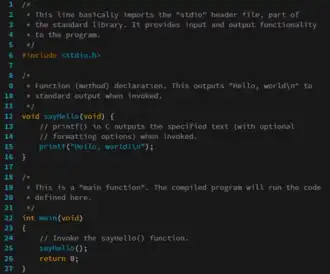
The source code for a computer program in C. The gray lines are comments that explain the program to humans. When compiled and run, it will give the output "Hello, world!".
A programming language is a system of notation for writing source code such as used to produce a computer program. A language allows a programmer to develop human readable content that can be consumed by a computer but only after translation via an automated process that enables source code to be executable. Historically, a compiler translates source code into machine code that is directly runnable by a computer, and an interpreter executes source code without converting to machine code. Today, hybrid technologies exist such as compiling to an intermediate form (such as bytecode) which is later interpreted or just-in-time compiled to machine code before running.
Computer architecture has strongly influenced the design of programming languages, with the most common type (imperative languages) developed to perform well on the popular von Neumann architecture. While early programming languages were closely tied to the hardware, modern languages hide hardware details via abstraction in an effort to enable better software with less effort. (Full article...) -
.svg.png)
Logo since August 17, 2012
Microsoft is a multinational computer technology corporation. Microsoft was founded on April 4, 1975, by Bill Gates and Paul Allen in Albuquerque, New Mexico. Its current best-selling products are the Microsoft Windows operating system; Microsoft Office, a suite of productivity software; Xbox, a line of entertainment of games, music, and video; Bing, a line of search engines; and Microsoft Azure, a cloud services platform.
In 1980, Microsoft formed a partnership with IBM to bundle Microsoft's operating system with IBM computers; with that deal, IBM paid Microsoft a royalty for every sale. In 1985, IBM requested Microsoft to develop a new operating system for their computers called OS/2. Microsoft produced that operating system, but also continued to sell their own alternative, which proved to be in direct competition with OS/2. Microsoft Windows eventually overshadowed OS/2 in terms of sales. When Microsoft launched several versions of Microsoft Windows in the 1990s, they had captured over 90% market share of the world's personal computers.
As of June 30, 2015, Microsoft has a global annual revenue of US$86.83 billion (~$109 billion in 2023) and 128,076 employees worldwide. It develops, manufactures, licenses, and supports a wide range of software products for computing devices. (Full article...) -
In computer systems a loader is the part of an operating system that is responsible for loading programs and libraries. It is one of the essential stages in the process of starting a program, as it places programs into memory and prepares them for execution. Loading a program involves either memory-mapping or copying the contents of the executable file containing the program instructions into memory, and then carrying out other required preparatory tasks to prepare the executable for running. Once loading is complete, the operating system starts the program by passing control to the loaded program code.
All operating systems that support program loading have loaders, apart from highly specialized computer systems that only have a fixed set of specialized programs. Embedded systems typically do not have loaders, and instead, the code executes directly from ROM or similar. In order to load the operating system itself, as part of booting, a specialized boot loader is used. In many operating systems, the loader resides permanently in memory, though some operating systems that support virtual memory may allow the loader to be located in a region of memory that is pageable.
In the case of operating systems that support virtual memory, the loader may not actually copy the contents of executable files into memory, but rather may simply declare to the virtual memory subsystem that there is a mapping between a region of memory allocated to contain the running program's code and the contents of the associated executable file. (See memory-mapped file.) The virtual memory subsystem is then made aware that pages with that region of memory need to be filled on demand if and when program execution actually hits those areas of unfilled memory. This may mean parts of a program's code are not actually copied into memory until they are actually used, and unused code may never be loaded into memory at all. (Full article...)


Selected images
-
 Partial map of the Internet based on the January 15, 2005 data found on opte.org. Each line is drawn between two nodes, representing two IP addresses. The length of the lines are indicative of the delay between those two nodes. This graph represents less than 30% of the Class C networks reachable by the data collection program in early 2005.
 -
 Deep Blue was a chess-playing expert system run on a unique purpose-built IBM supercomputer. It was the first computer to win a game, and the first to win a match, against a reigning world champion under regular time controls. Photo taken at the Computer History Museum.
 -
 Animation of a Non-uniform rational B-spline surface. Modeled and rendered in Cobalt.
 -
 Partial view of the Mandelbrot set. Step 1 of a zoom sequence: Gap between the "head" and the "body" also called the "seahorse valley".
 -
_in_Dark_theme.png) GNOME Shell, GNOME Clocks, Evince, gThumb and GNOME Files at version 3.30, in a dark theme
GNOME Shell, GNOME Clocks, Evince, gThumb and GNOME Files at version 3.30, in a dark theme -
 Bill Gosper's Glider Gun in action
 -
 An IBM Port-A-Punch punched card
 -

-

-
 A head crash on a modern hard disk drive
 -
 A view of the GNU nano Text editor version 6.0
 -
 This image (when viewed in full size, 1000 pixels wide) contains 1 million pixels, each of a different color.
 -
 Ada Lovelace was an English mathematician and writer, chiefly known for her work on Charles Babbage's proposed mechanical general-purpose computer, the Analytical Engine. She was the first to recognize that the machine had applications beyond pure calculation, and to have published the first algorithm intended to be carried out by such a machine. As a result, she is often regarded as the first computer programmer.
 -
 Grace Hopper at the UNIVAC keyboard, c. 1960. Grace Brewster Murray: American mathematician and rear admiral in the U.S. Navy who was a pioneer in developing computer technology, helping to devise UNIVAC I. the first commercial electronic computer, and naval applications for COBOL (common-business-oriented language).
 -
 Margaret Hamilton standing next to the navigation software that she and her MIT team produced for the Apollo Project.
 -
 Stephen Wolfram is a British-American computer scientist, physicist, and businessman. He is known for his work in computer science, mathematics, and in theoretical physics.
 -
 Output from a (linearised) shallow water equation model of water in a bathtub. The water experiences 5 splashes which generate surface gravity waves that propagate away from the splash locations and reflect off of the bathtub walls.
 -
 A lone house. An image made using Blender 3D.
Did you know? -

- ... that the programming language Acorn System BASIC was so non-standard that one commenter suggested that using it on the BBC Micro would be a disaster?
- ... that Cornell University's student-oriented programming language dialect was made available to other universities but required a "research grant" payment in exchange?
- ... that it took a particle accelerator and machine-learning algorithms to extract the charred text of PHerc. Paris. 4 without unrolling it?
- ... that the study of selection algorithms has been traced to an 1883 work of Lewis Carroll on how to award second place in single-elimination tournaments?
- ... that the Gale–Shapley algorithm was used to assign medical students to residencies long before its publication by Gale and Shapley?
- ... that a "hacker" with blog posts written by ChatGPT was at the center of an online scavenger hunt promoting Avenged Sevenfold's album Life Is but a Dream...?
Subcategories

WikiProjects

- There are many users interested in computer programming, join them.
- WikiProject Computing
- WikiProject Computer science
- WikiProject C/C++
- WikiProject Java
- WikiProject Cryptography
- WikiProject Software
Computer programming news
- 23 May 2025 –
- Authorities from Canada, Denmark, France, Germany, the Netherlands, the United Kingdom, and the U.S. announce a joint operation to crack down on malware around the world, which took down over 300 servers, neutralized 650 domains, and seized over €3.5 million (US$3.9 million) of cryptocurrency. (DW)
Topics


|

Related portals



.svg.png)
Associated Wikimedia
The following Wikimedia Foundation sister projects provide more on this subject:
-
 Commons
Free media repository -
 Wikibooks
Free textbooks and manuals -
 Wikidata
Free knowledge base -
 Wikinews
Free-content news -
 Wikiquote
Collection of quotations -
 Wikisource
Free-content library -
 Wikiversity
Free learning tools -
 Wiktionary
Dictionary and thesaurus
-
 List of all portals
 -

-

-

-

-

-

-

-

-

-
 Random portal
 -
 WikiProject Portals