Portal:Internet

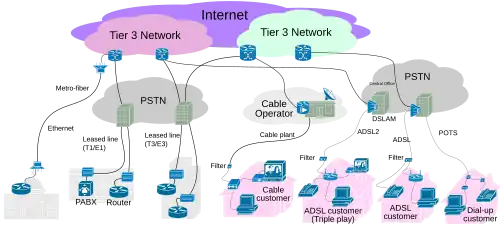
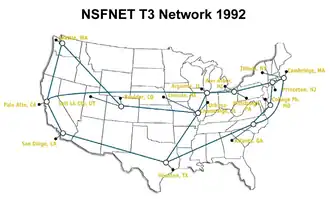
The Internet Portal  The Internet (or internet) is the global system of interconnected computer networks that uses the Internet protocol suite (TCP/IP) to communicate between networks and devices. It is a network of networks that consists of private, public, academic, business, and government networks of local to global scope, linked by a broad array of electronic, wireless, and optical networking technologies. The Internet carries a vast range of information resources and services, such as the interlinked hypertext documents and applications of the World Wide Web (WWW), electronic mail, internet telephony, streaming media and file sharing. The origins of the Internet date back to research that enabled the time-sharing of computer resources, the development of packet switching in the 1960s and the design of computer networks for data communication. The set of rules (communication protocols) to enable internetworking on the Internet arose from research and development commissioned in the 1970s by the Defense Advanced Research Projects Agency (DARPA) of the United States Department of Defense in collaboration with universities and researchers across the United States and in the United Kingdom and France. The ARPANET initially served as a backbone for the interconnection of regional academic and military networks in the United States to enable resource sharing. The funding of the National Science Foundation Network as a new backbone in the 1980s, as well as private funding for other commercial extensions, encouraged worldwide participation in the development of new networking technologies and the merger of many networks using DARPA's Internet protocol suite. The linking of commercial networks and enterprises by the early 1990s, as well as the advent of the World Wide Web, marked the beginning of the transition to the modern Internet, and generated sustained exponential growth as generations of institutional, personal, and mobile computers were connected to the internetwork. Although the Internet was widely used by academia in the 1980s, the subsequent commercialization of the Internet in the 1990s and beyond incorporated its services and technologies into virtually every aspect of modern life. (Full article...) Selected article The Signpost (formerly The Wikipedia Signpost) is the English Wikipedia's online newspaper. Managed by the volunteer community, it is published online with contributions from Wikimedia editors. The newspaper's scope includes the Wikimedia community and events related to Wikipedia, including Arbitration Committee rulings, Wikimedia Foundation issues, and other Wikipedia-related projects. It was founded in January 2005 by Wikipedian Michael Snow, who continued as a contributor until his February 2008 appointment to the Wikimedia Foundation's Board of Trustees. Former editor-in-chief The ed17 noted that during his tenure, from 2012 to 2015, the publication expanded its scope to report on the wider Wikimedia movement in addition to Wikipedia and its community. After it reported on the changes to European freedom of panorama law in June 2015, a number of publications referred to The Signpost for further information. (Full article...) Selected picture Voice over Internet Protocol (VoIP) is a protocol optimized for the transmission of voice through the Internet or other packet switched networks. VoIP is often used abstractly to refer to the actual transmission of voice (rather than the protocol implementing it). VoIP is also known as IP Telephony, Internet telephony, Broadband telephony, Broadband Phone and Voice over Broadband. "VoIP" is pronounced voyp. Good Articles -On March 22, 2016, programmer Azer Koçulu took down the Several hours after the package was removed from npm, the company behind the platform, npm, Inc., manually restored the package. Later, npm disabled the ability to remove a package if more than 24 hours have elapsed since its publishing date and at least one other project depends on it. The incident drew widespread media attention and reactions from people in the software industry. The removal of WikiProjects
Did you know (auto-generated) -
Selected biography
General images -The following are images from various internet-related articles on Wikipedia.
Selected quoteMain topics
Featured contentCategories Select [►] to view subcategories
Internet Internet by continent Internet by country Internet-related lists Internet access Internet architecture Internet broadcasting Internet culture Internet databases Email Internet events Internet governance History of the Internet Internet hosting Hypermedia Internet Geographic information systems Internet law Online algorithms Internet-related organizations People related to the internet Politics and the Internet Internet security Internet Standards Internet terminology Videotelephony Works about the Internet World Wide Web Internet stubs Related portalsThings you can do
Associated WikimediaThe following Wikimedia Foundation sister projects provide more on this subject:
Wikipedia's portalsDiscover Wikipedia using portals
|


-en.svg.png)


_(page_62_crop).jpg)





.svg.png)


