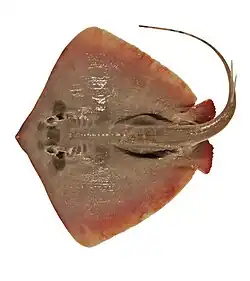
The Atlantic torpedo (Tetronarce nobiliana) is a species of electric ray in the familyTorpedinidae. It is found in the Atlantic Ocean, from Nova Scotia to Brazil in the west and from Scotland to West Africa and off southern Africa in the east, occurring at depths of up to 800 m (2,600 ft), and in the Mediterranean Sea. Younger individuals generally inhabit shallower, sandy or muddy habitats, whereas adults are more pelagic in nature and frequent open water. Up to 1.8 m (6 ft) long and weighing 90 kg (200 lb), the Atlantic torpedo is the largest known electric ray. Like other members of its genus, it has an almost circular pectoral fin disk with a nearly straight leading margin, and a robust tail with a large triangular caudal fin. Distinctive characteristics include its uniform dark color, smooth-rimmed spiracles (paired respiratory openings behind the eyes), and two dorsal fins of unequal size.
Solitary and nocturnal, the Atlantic torpedo is capable of generating up to 220 volts of electricity to subdue its prey or defend itself against predators. Its diet consists mainly of bony fishes, though it also feeds on small sharks and crustaceans. It is an aplacental viviparous species, wherein the developing embryos are nourished by yolk and later maternally provided histotroph ("uterine milk"). Females give birth to up to 60 young following a gestation period of one year. The electric shock of this species can be quite severe and painful, though it is not fatal. Because of its electrogenic properties, the Atlantic torpedo was used in medicine by the Ancient Greeks and Romans and became the namesake of the naval weapon. Prior to the 19th century, its liver oil was used as lamp fuel, but it is no longer of any economic value. The International Union for Conservation of Nature (IUCN) has listed this species as Least Concern; it is caught unintentionally by commercial and recreational fishers, but the impact of these activities on its population is unknown. (Full article...)
Image 2
Male
The Atlantic blue marlin (Makaira nigricans) is a species of marlin endemic to the Atlantic Ocean. It is closely related to, and usually considered conspecific with, the Indo-Pacific blue marlin, then simply called blue marlin. Some authorities consider both species distinct.
The Atlantic blue marlin (hereafter, blue marlin) feeds on a wide variety of organisms near the surface. It uses its bill to stun, injure, or kill while knifing through a school of fish or other prey, then returns to eat the injured or stunned fish. Marlin is a popular game fish. The relatively high fat content of its meat makes it commercially valuable in certain markets. It is the national fish of the Commonwealth of The Bahamas and is featured on its coat of arms. (Full article...)
Image 3
The spinner shark (Carcharhinus brevipinna) is a type of requiem shark, in the family Carcharhinidae, named for the spinning leaps it makes as a part of its feeding strategy. This species occurs in tropical and warm temperate waters worldwide, except for in the eastern Pacific Ocean. It is found from coastal to offshore habitats to a depth of 100 m (330 ft), though it prefers shallow water. The spinner shark resembles a larger version of the blacktip shark (C. limbatus), with a slender body, long snout, and black-marked fins. This species can be distinguished from the blacktip shark by the first dorsal fin, which has a different shape and is placed further back, and by the black tip on the anal fin (in adults only). It attains a maximum length of 3 m (9.8 ft).
Spinner sharks are swift and gregarious predators that feed on a wide variety of small bony fishes and cephalopods. When feeding on schools of forage fish, they speed vertically through the school while spinning on their axis, erupting from the water at the end. Like other members of its family, the spinner shark is viviparous, with females bearing litters of three to 20 young every other year. The young are born in shallow nursery areas near the coast, and are relatively fast-growing. This species is not usually dangerous to humans, but may become belligerent when excited by food. Spinner sharks are valued by commercial fisheries across their range for their meat, fins, liver oil, and skin. They are also esteemed as strong fighters by recreational fishers. The International Union for Conservation of Nature has assessed this species as Vulnerable worldwide. (Full article...)
Image 4
Toxotes chatareus, sometimes known by the common namescommon archerfish, seven-spot archerfish or largescale archerfish, is a species of perciform fish in the archerfish genus Toxotes.
They are usually no larger than 20 centimetres (7.9 in) but may grow up to 40 centimetres (16 in). Unlike most archerfish, T. chatareus are sooty rather than silvery in colour. They are omnivorous, feeding on insects, fish, and vegetative matter at the surface of the water. Breeding occurs in the wet season, and 20,000 to 150,000 eggs may be laid at one time. (Full article...)
The blacktip reef shark (Carcharhinus melanopterus) is a species of requiem shark, in the family Carcharhinidae, which can be easily identified by the prominent black tips on its fins (especially on the first dorsal fin and its caudal fin). Among the most abundant sharks inhabiting the tropicalcoral reefs of the Indian and Pacific Oceans, this species prefers shallow, inshore waters. Its exposed first dorsal fin is a common sight in the region. The blacktip reef shark is usually found over reef ledges and sandy flats, though it has also been known to enter brackish and freshwater environments. It typically attains a length of 1.6 m (5.2 ft). Like other sharks, the females are larger than the males.
The blacktip reef shark has extremely small home ranges and exhibits strong site fidelity, remaining within the same local area for up to several years at a time. It is an active predator of small bony fish, cephalopods, and crustaceans, and has also been known to feed on sea snakes and seabirds. Accounts of the blacktip reef shark's life history have been variable and sometimes contradictory, in part reflecting geographical differences within the species. Like other members of its family, this shark is viviparous, with females giving birth to two to five young on a biennial, annual, or possibly biannual cycle. Reports of the gestation period range from 7–9, through 10–11, to possibly 16 months. Mating is preceded by the male following closely behind the female, likely attracted by her chemical signals. Newborn sharks are found further inshore and in shallower water than adults, frequently roaming in large groups over areas flooded by high tide. (Full article...)
Image 6
The plain maskray (Neotrygon annotata) or brown stingray, is a species of stingray in the familyDasyatidae. It is found in shallow, soft-bottomed habitats off northern Australia. Reaching 24 cm (9.4 in) in width, this species has a diamond-shaped, grayish green pectoral fin disc. Its short, whip-like tail has alternating black and white bands with fin folds above and below. There are short rows of thorns on the back and the base of the tail, but otherwise the skin is smooth. While this species possesses the dark mask-like pattern across its eyes common to its genus, it is not ornately patterned like other maskrays.
The coral catshark (Atelomycterus marmoratus) is a species of coloured catshark belonging to the familyAtelomycteridae. It is common on shallow coral reefs across the Indo-West Pacific, from Pakistan to New Guinea. Reaching up to 70 cm (28 in) in length, the coral catshark has an extremely slender body, a short head and tail, and two dorsal fins that are angled backwards. It can be identified by the numerous black and white spots on its back, sides, and fins, which often merge to form horizontal bars. Furthermore, adult males have distinctively long and thin claspers.
The sparsely spotted stingaree (Urolophus paucimaculatus), also known as the white-spotted stingaree or Dixon's stingaree, is a species of stingray in the familyUrolophidae, common off the southern Australian coast. Preferring sandy flats and seagrass beds, this benthic ray can be found from close to shore to a depth of at least 150 m (490 ft), and tends to occur deeper in the northern portion of its range. Reaching a length of 57 cm (22 in), this species has a broad, diamond-shaped pectoral fin disc that is typically plain gray in color above with a V-shaped marking between the eyes. Individuals from southerly waters also generally exhibit a smattering of small, dark-edged white spots. This ray is further characterized by a distinctively bell-shaped curtain of skin between the nostrils. Its tail has a skin fold running along either side and a leaf-shaped caudal fin, but no dorsal fin.
Relatively inactive during daytime, the sparsely spotted stingaree preys mainly on crustaceans, and to a much lesser extent on polychaete worms and other small benthic organisms. It is aplacental viviparous, with the mother provisioning her young with histotroph ("uterine milk"). Life history differs between the eastern and western subpopulations: eastern females bear litters of up to six pups with a twelve-month gestation period, while western females bear litters of only one or two pups with a ten-month gestation period. Also, western rays mature later and live longer than eastern rays. The venomous sting of the sparsely spotted stingaree is potentially injurious to humans, and it has been reported to react aggressively if disturbed. The International Union for Conservation of Nature (IUCN) has listed it under Least Concern, as there is little fishing activity over the majority of its range. (Full article...)
Image 9
Top: Female P. pulcher bottom: Male P. pulcher
Pelvicachromis pulcher is a freshwater fish of the cichlid family, endemic to Nigeria and Cameroon. It is popular amongst aquarium hobbyists, and is most commonly sold under the name kribensis, although it has other common names, including various derivatives and color morphs of the kribensis: krib, common krib, red krib, super-red krib and rainbow krib, along with rainbow cichlid and purple cichlid. (Full article...)
Paddlefish (family Polyodontidae) are a family of ray-finned fish belonging to order Acipenseriformes, and one of two living groups of the order alongside sturgeons (Acipenseridae). They are distinguished from other fish by their elongated rostra, which are thought to enhance electroreception to detect prey. Paddlefish have been referred to as "primitive fish" because the Acipenseriformes are among the earliest diverging lineages of ray-finned fish, having diverged from all other living groups over 300 million years ago. Both living and fossil paddlefish are found almost exclusively in North America and China.
Eight species are known: Six of those species are extinct, and known only from fossils (five from North America, one from China), one of the extant species, the American paddlefish (Polyodon spathula), is native to the Mississippi River basin in the U.S. The other is the Chinese paddlefish (Psephurus gladius), which was declared extinct in 2022 following a 2019 recommendation; the species has not been sighted in the Yangtze River Basin in China since 2003. Chinese paddlefish are also commonly referred to as "Chinese swordfish", or "elephant fish". The earliest known paddlefish is Protopsephurus, from the early Cretaceous (Aptian) of China, dating to around 120 million years ago. (Full article...)
Image 11
The bigeye thresher (Alopias superciliosus) is a species of thresher shark, family Alopiidae, found in temperate and tropical oceans worldwide. Like the other thresher sharks, nearly half its total length consists of the elongated upper lobe of the tail fin. Its common name comes from its enormous eyes, which are placed in keyhole-shaped sockets that allow them to be rotated upward. This species can also be distinguished by a pair of deep grooves on the top of its head, from which its scientific name is derived.
The large eyes of the bigeye thresher are adapted for hunting in low light conditions. It is one of the few sharks that conduct a diel vertical migration, staying in deep water during the day and moving into surface waters at night to feed. To protect its sensitive brain and eyes from the temperature changes accompanying these movements, the bigeye thresher has a vascular exchange system called the rete mirabile around those organs. This species feeds mainly on fish and squid, which are stunned via whip-like strikes of the long tail. Bigeye threshers are ovoviviparous, usually bearing litters of two pups. The embryos are oophagous and feed on ova produced by the mother while inside the uterus. This shark is caught by commercial fisheries across its range; the meat is not highly regarded but the skin, fins, and liver oil are valued. It has been assessed as Vulnerable by the International Union for Conservation of Nature (IUCN). (Full article...)
Image 12
The goblin shark (Mitsukurina owstoni) is a rare species of deep-sea shark. Sometimes called a "living fossil", it is the only extant representative of the familyMitsukurinidae, a lineage some 125 million years old. This pink-skinned animal has a distinctive profile with an elongated, flat snout, and highly protrusible jaws containing prominent nail-like teeth. It typically reaches a length of 3 to 4 meters (10 to 13 feet) when fully grown, although it can grow significantly larger—such as one specimen captured in 2000, which was believed to measure around 6 meters (20 feet). Goblin sharks are benthopelagic creatures that inhabit upper continental slopes, submarine canyons, and seamounts throughout the world at depths greater than 100 m (330 ft), with adults found deeper than juveniles. Some researchers believed that these sharks could also dive to depths of up to 1,300 m (4,270 ft), for short periods; footage captured in 2024 suggests that their range could be deeper than previously thought, with a confirmed sighting of an adult swimming at 2,000 m (6,560 ft).
Yarrell was a London bookseller and newsagent with the time and income to indulge his interest in natural history. He was a prominent member of several natural history societies and knew most of the leading British naturalists of his day. He was able to draw on his own extensive library and collection of specimens, his wide network of like-minded naturalist friends, and his access to major libraries to garner material for his writings, the most important of which were A History of British Fishes and the 1843 A History of British Birds. (Full article...)
Image 14
The creek whaler (Carcharhinus fitzroyensis) is a common species of requiem shark, and part of the family Carcharhinidae, endemic to northern Australia. It frequents shallow waters close to shore, including estuaries. This small, stocky shark usually grows to 1.0–1.3 m (3.3–4.3 ft) long and is brownish in color without conspicuous fin markings. It can be identified by its long snout, large, triangular pectoral fins, and large, anteriorly positioned first dorsal fin.
The diet of the creek whaler consists mainly of small teleost fishes and crustaceans. It is viviparous, with the unborn young being sustained through a placental connection. The defined mating season lasts from May to July. Females give birth to one to seven pups annually, following a gestation period of seven to 9 months. A small number of creek whalers are caught incidentally in inshoregillnets and used for food, but the effect of fishing on its population seems to be inconsequential. As a result, the IUCN has listed this species under Least Concern. (Full article...)
Image 15
The zebra shark (Stegostoma tigrinum) is a species of carpet shark and the sole member of the family Stegostomatidae. It is found throughout the tropical Indo-Pacific, frequenting coral reefs and sandy flats to a depth of 62 m (200 ft). Zebra sharks are distinctive in appearance, with adults possessing five longitudinal ridges on a cylindrical body, a low caudal fin comprising nearly half the total length, and typically a pattern of dark spots on a pale background. Young zebra sharks under 50–90 cm (20–35 in) long have a completely different pattern, consisting of light vertical stripes on a brown background, and lack the ridges. This species attains a length of 2.5 m (8.2 ft).
Billfish are pelagic and highly migratory, and are found in all oceans. Although they usually inhabit tropical and subtropical waters, swordfish are also found in temperate waters. Billfish use their long spear/sword-like upper beaks to slash at and stun prey during feeding. Their bills have been known to impale prey, and have sometimes even accidentally impaled boats and people, but they are not intentionally used for this purpose. They are highly valued as game fish by sports fishermen. (Full article...)
... that male fish in the subclass Holocephali often have special organs on top of their head that are used to grasp females while mating?
... that Ivan Beshoff, the last survivor of the mutiny on the Potemkin, emigrated to Ireland where he established a fish and chip shop that is still run by his descendants?
... that marmalade, mashed potato and fish knives were all used in the book Class to identify different British social classes?
... that at a maximum standard length of roughly 2 cm (0.8 in), dwarf pufferfish are some of the smallest pufferfish in the world?
... that the New Zealand fishing company Sealord Group is half-owned by iwi?
General images -
The following are images from various fish-related articles on Wikipedia.
Image 1The giant whale shark, another resident of the ocean epipelagic zone, filter feeds on plankton, and periodically dives deep into the mesopelagic zone. (from Pelagic fish)
Image 15Young, red flabby whalefish make nightly vertical migrations into the lower mesopelagic zone to feed on copepods. When males mature into adults, they develop a massive liver and then their jaws fuse shut. They no longer eat, but continue to metabolise the energy stored in their liver. (from Pelagic fish)
Image 16Most mesopelagic fishes are small filter feeders that ascend at night to feed in the nutrient rich waters of the epipelagic zone. During the day, they return to the dark, cold, oxygen-deficient waters of the mesopelagic where they are relatively safe from predators. Lanternfish account for as much as 65% of all deep sea fish biomass and are largely responsible for the deep scattering layer of the world's oceans. (from Pelagic fish)
Image 17Many bristlemouth species, such as the "spark anglemouth" above, are also bathypelagic ambush predators that can swallow prey larger than themselves. They are among the most abundant of all vertebrate families. (from Pelagic fish)
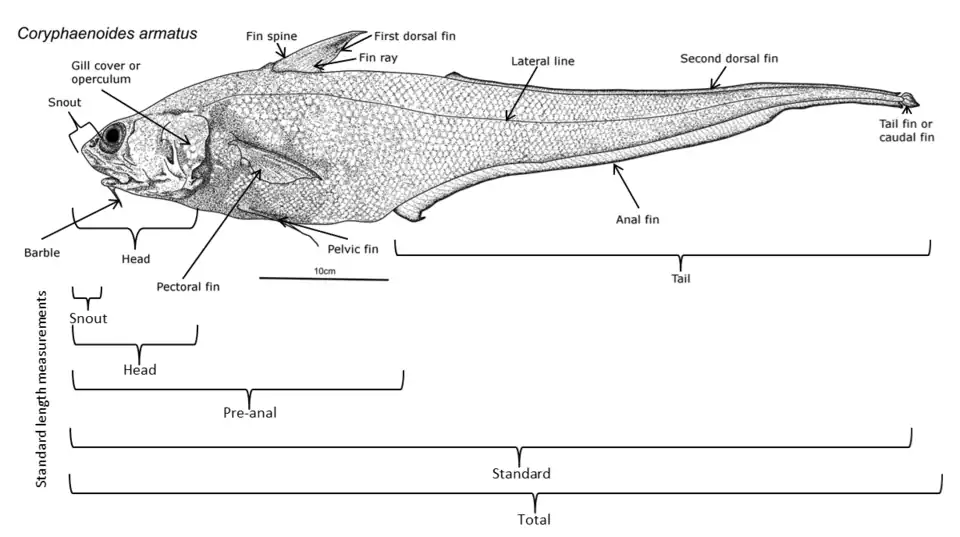
Image 18An annotated diagram of the basic external features of an abyssal grenadier and standard length measurements. (from Deep-sea fish)
Image 19The daggertooth paralyses other mesopelagic fish when it bites them with its dagger-like teeth (from Deep-sea fish)
Image 25Scale diagram of the layers of the pelagic zone (from Deep-sea fish)
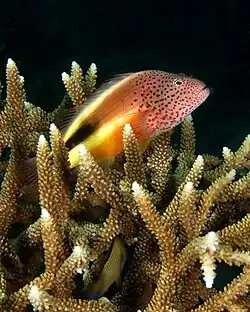
Image 26In the foreground is an orange-lined triggerfish displaying spines. Triggerfish have mouths that crush shells. Orange-lined triggerfish are particularly aggressive. The black and white fish are three-stripe damselfish and the unstriped fish are blue-green chromis damselfish. If the triggerfish attacks, the damselfish will hide in the nearby cauliflower coral. If the triggerfish wants to hide, it will squeeze into a coral crevice and lock itself in place with its spines. (from Coral reef fish)
Image 27Demersal fish output in 2005 (from Demersal fish)
Image 28Bigeye tuna cruise the epipelagic zone at night and the mesopelagic zone during the day (from Deep-sea fish)
Image 36Surgeonfish are among the most common of coral reef herbivores, often feeding in shoals. This may be a mechanism for overwhelming the highly aggressive defence responses of small territorial damselfishes that vigorously guard small patches of algae on coral reefs. (from Coral reef fish)
Image 37The humpback anglerfish is a bathypelagic ambush predator, which attracts prey with a bioluminescent lure. It can ingest prey larger than itself, which it swallows with an inrush of water when it opens its mouth. (from Pelagic fish)
Image 46Lanternfish are partial residents of the ocean epipelagic zone During the day they hide in deep waters, but at night they migrate up to surface waters to feed. (from Pelagic fish)
Image 47Red snapper, are generalized reef feeders with standard jaw and mouth structures that allow them to eat almost anything, though they prefer small fish and crustaceans. (from Coral reef fish)
Image 52Shortfin mako shark make long seasonal migrations. They appear to follow temperature gradients, and have been recorded travelling more than 4,500 km in one year. (from Pelagic fish)
Image 53The stoplight loosejaw has a lower jaw one-quarter as long as its body. The jaw has no floor and is attached only by a hinge and a modified tongue bone. Large fang-like teeth in the front are followed by many small barbed teeth. (from Deep-sea fish)
Image 56The stoplight loosejaw is also one of the few fishes that produce red bioluminescence. As most of their prey cannot perceive red light, this allows it to hunt with an essentially invisible beam of light. (from Deep-sea fish)
Image 57Pacific decadal anomalies – April 2008 (from Pelagic fish)
Image 58Coral reefs support flourishing ecosystems, paradoxically in clear, low nutrient waters, along tropical continental coasts and around volcanic islands. Coral reef fish are numerous and diverse. (from Coastal fish)
Image 59Areas of upwelling in red (from Pelagic fish)
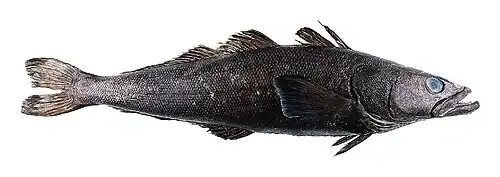
Image 68Cod-like fishes, like this morid cod have a barbel (fleshy filament) on their lower jaw which they use to detect prey buried in the sand or mud. (from Coastal fish)
Image 70Long-snouted lancetfish. Lancetfish are ambush predators which spend all their time in the mesopelagic zone. They are among the largest mesopelagic fishes (up to 2 m (6.6 ft). (from Deep-sea fish)
Image 71Humans seldom encounter frilled sharks alive, so they pose little danger (though scientists have accidentally cut themselves examining their teeth). (from Deep-sea fish)
Image 72Some flatfish can camouflage themselves on the ocean floor (from Demersal fish)
Image 76The stargazer is an ambush predator which can deliver both venom and electric shocks. It has been called "the meanest thing in creation". (from Coastal fish)
Image 79Most of the rest of the mesopelagic fishes are ambush predators, such as this sabertooth fish. The sabertooth uses its telescopic, upward-pointing eyes to pick out prey silhouetted against the gloom above. Their recurved teeth prevent a captured fish from backing out. (from Pelagic fish)
The Peacock flounder (Bothus mancus) is a species of lefteye flounder found widely in relatively shallow waters in the Indo-Pacific. This photomontage shows four separate views of the same fish, each several minutes apart, starting from the top left. Over the course of the photos, the fish changes its colors to match its new surroundings, and then finally (bottom right) buries itself in the sand, leaving only the eyes protruding.
A sketch of a longnose sawshark (Pristiophorus cirratus), a species of sawshark found in the eastern Indian Ocean around southern Australia on the continental shelf at depths of between 40 and 310 m (130 and 1,020 ft). It is a medium-sized shark with a saw-like flattened snout which measures up to thirty percent of its body size.
The Oscar (Astronotus ocellatus) is a species of fish from the cichlidfamily. In South America, where the species occurs, they are often found for sale as a food fish in the local markets. The species is also a popular aquarium fish. They have been reported to grow to a length of 45 cm (ca. 18 in) and a mass of 1.6 kg (3.5 lb).
People jigging—fishing with a type of lure known as a "jig"—for squid in Queenscliff, Victoria, Australia. A jig consists of a lead sinker with a hook molded into it and usually covered by a soft body to attract fish. Jigs are intended to create a jerky, vertical motion, as opposed to spinnerbaits which move through the water horizontally.
The flying gurnard is a fish of tropical to warm temperate waters on both sides of the Atlantic Ocean. When excited, it spreads its "wings", semi-transparent appendages tipped with a phosphorescent bright blue coloration which are used to frighten predators.
A plate with fossils of Pseudostacus sp. (lobster, left) and Diplomystus birdii (fish, right), from the Hakel paleontological formation in Lebanon. The paleontological sites of Lebanon contain deposits of some of the best-preserved fossils in the world, and include some species found nowhere else. The most famous of these is the Lebanese lagerstätten of the Late Cretaceous age.
The orbicular batfish (Platax orbicularis) is a batfish endemic to the Indian and Pacific Oceans. It has a thin, disc-shaped body, and male can grow up to 50 centimetres (20 in) in length. In the wild, the orbicular batfish lives in brackish or marine waters, usually around reefs, at depths from 5 to 30 metres (20 to 100 ft). It is also a popular aquarium fish, although captive specimens generally do not grow as long as wild ones.
An Atlantic salmon (Salmo salar) egg hatching. The Alevin (larva) has grown around the remains of the yolk sac - visible are the arteries spinning around the yolk and little oildrops, also the gut, the spine, the main caudalblood vessel, the bladder and the arcs of the gills. In about 24 hours it will be a fry without yolk sac.
The leopard shark (Triakis semifasciata) is a species of hound shark found along the Pacific coast of North America from the U.S. state of Oregon to Mazatlán in Mexico. Typically measuring 1.2–1.5 m (3.9–4.9 ft) long, this slender-bodied shark is characterized by black saddle-like markings and large spots over its back.
The Siamese fighting fish (Betta splendens), or fighting betta is a freshwaterfish related to the paradise fish. The fighting fish is a species in the Gourami family which is popular as an aquarium fish. They are called pla-kad (biting fish) in Thai or trey krem in Khmer. They are a very territorial fish and it is unwise to house two males together. Even the females may become territorial towards each other if not housed in a large enough tank.
In American English, the name gar (or garpike) is strictly applied to members of the Lepisosteidae, a family including seven living species of fish in two genera that inhabit fresh, brackish, and occasionally marine, waters of eastern North America, Central America, and the Caribbean islands.
The mandarinfish (Synchiropus splendidus, not to be confused with the similarly named mandarin fish) is a small (~6 cm or 2.4 in), brightly-colored member of the dragonet family, popular in the saltwater aquarium trade. The mandarinfish is native to the Western Pacific, ranging approximately from the Ryukyu Islands south to Australia.
The Eurasian ruffe (Gymnocephalus cernua) is a species of freshwater fish found in temperate regions of Europe and Asia. The aggressive fish is known to reproduce rapidly, leading to problems when it is introduced to foreign bodies of water.
Selected quote
"I should have gone to college and gone into real estate and got myself an aquarium, that's what I should have done."
---Jeffrey Dahmer, American serial killer and sex offender (1960–1994)
The Mini Edition of the Fish Portal is available for you to use on your wikipedia user page or talk page. It uses minimum space but retains many crucial features of the portal. To use it, place {{Portal:Fish/Mini portal}} on the designated page. See here for an example of the mini portal on a user page.
WikiProjects
WikiProject Fishes
WikiProject Aquarium Fishes
WikiProject Sharks
WikiProject Fishing
See also
For additional lists of marine life-related featured articles and good articles see:
The Fish Quiz is a friendly quiz competition designed to test your general knowledge of fish. The current game is Fish Quiz Tournament X. You can read more and join the game here.
Associated Wikimedia
The following Wikimedia Foundation sister projects provide more on this subject:

_by_Nick_Hobgood.jpg)


_Moorea_5.jpg)









.gif)


.jpg)


_Saw_shark_-_William_Buelow_Gould%252C_c1832.jpg)


.jpg)


.jpg)


