Portal:Sharks

Welcome to the shark portal

Sharks are a group of elasmobranch cartilaginous fishes characterized by a ribless endoskeleton, dermal denticles, five to seven gill slits on each side, and pectoral fins that are not fused to the head. Modern sharks are classified within the division Selachii and are the sister group to the Batomorphi (rays and skates). Some sources extend the term "shark" as an informal category including extinct members of Chondrichthyes (cartilaginous fish) with a shark-like morphology, such as hybodonts. Shark-like chondrichthyans such as Cladoselache and Doliodus first appeared in the Devonian Period (419–359 million years), though some fossilized chondrichthyan-like scales are as old as the Late Ordovician (458–444 million years ago). The earliest confirmed modern sharks (Selachii) are known from the Early Jurassic around 200 million years ago, with the oldest known member being Agaleus, though records of true sharks may extend back as far as the Permian.
Sharks range in size from the small dwarf lanternshark (Etmopterus perryi), a deep sea species that is only 17 centimetres (6.7 in) in length, to the whale shark (Rhincodon typus), the largest fish in the world, which reaches approximately 12 metres (40 ft) in length. They are found in all seas and are common to depths up to 2,000 metres (6,600 ft). They generally do not live in freshwater, although there are a few known exceptions, such as the bull shark and the river sharks, which can be found in both seawater and freshwater, and the Ganges shark, which lives only in freshwater. Sharks have a covering of placoid scales (denticles) that protects the skin from damage and parasites in addition to improving their fluid dynamics. They have numerous sets of replaceable teeth.
Several shark species are apex predators, which are organisms that are at the top of their food chain with select examples including the bull shark, tiger shark, great white shark, mako sharks, thresher sharks and hammerhead sharks. Some sharks are filter-feeding planktivores, such as the whale shark and basking shark, which are among the largest fish ever lived. (Full article...)
Selected article -

Slow-moving, generally solitary predators, horn sharks hunt at night inside small home ranges and retreat to a favored shelter during the day. Their daily activity cycles are controlled by environmental light levels. Adult sharks prey mainly on hard-shelled molluscs, echinoderms, and crustaceans, which they crush between powerful jaws and molar-like teeth, while also feeding opportunistically on a wide variety of other invertebrates and small bony fishes. Juveniles prefer softer-bodied prey such as polychaete worms and sea anemones. The shark extracts its prey from the substrate using suction and, if necessary, levering motions with its body. Reproduction is oviparous, with females laying up to 24 eggs from February to April. After laying, the female picks up the auger-shaped egg cases and wedges them into crevices to protect them from predators.
Horn sharks are harmless unless harassed, and are readily maintained in captivity. They are not targeted by either commercial or recreational fisheries, though small numbers are caught as bycatch. In Mexico this species is used for food and fishmeal, and in California its spines are made into jewelry. The International Union for Conservation of Nature (IUCN) does not yet have enough information to determine the horn shark's conservation status. It faces few threats off the coast of the United States.
Did you know (auto-generated)

- ... that the parasitic copepod Driocephalus cerebrinoxius burrows into the brains of sharks through their noses?
- ... that a shark cost a competitor a silver medal in the spearfishing event at the 2014 Micronesian Games?
- ... that Hixxy and Sharkey created a schism in the UK rave music scene in 1995?
Categories

Related portals


WikiProjects

WikiProjects related to sharks:
- WikiProject Science
- WikiProject Biology
- WikiProject Tree of Life
- WikiProject Animals
- WikiProject Fishes
- WikiProject Sharks
- WikiProject Fishes
- WikiProject Animals
- WikiProject Tree of Life
- WikiProject Biology
- WikiProject Aquarium Fishes
- WikiProject Fishing
Selected picture -

More Did you know? -
- ... that the milk shark is so named because of a belief in India that eating its meat improves lactation?
- ... that the silky shark is the most common source of ornamental shark jaws sold to tourists in the tropics?
- ... that the southern African frilled shark preys mainly on smaller sharks, which it swallows whole with its greatly distensible mouth?
- ... that more than 90 percent of the night sharks caught off northeastern Brazil contain mercury concentrations higher than that considered safe by the local government?
- ... that the largetooth cookiecutter shark has the largest teeth relative to its body of any living shark?
General images
-
This grey reef shark demonstrates countershading, with its darker dorsal surface and lighter ventral surface. (from Shark anatomy)
-
 Clear agonistic behaviour observed in Great White Shark (from Shark agonistic display)
 -
 Depiction of shark anatomy including eggs, pups, and the liver (from Shark anatomy)
 -
 Lateral and cross section view of shark's red and white locomotor muscles (from Shark anatomy)
 -
 Anti-cull protesters on Perth's Cottesloe Beach in Western Australia in 2014 (from Shark culling)
 -
_(46722837981).jpg) Sharksucker (Echeneis naucrates) (from Shark agonistic display)
Sharksucker (Echeneis naucrates) (from Shark agonistic display) -
 The gill slits of a whale shark flaring as it expels water from its pharyngeal cavity. (from Shark anatomy)
 -

-
 The whale shark, the world's largest fish, is classified as Endangered.(from List of threatened sharks)
Binding legislation and harvest management strategies... are urgently needed to address the disproportionate impact of fisheries on cartilaginous fishes.
– IUCN global study 2010 -
 A sign at Pyramid Rock Beach in Hawaii warning about a shark sighting, 2015 (from Shark tourism)
 -
 The major features of sharks (from Shark anatomy)
 -
 Postural configuration of a Gray Reef Shark as it displays agonistic behaviour, in a sculpture (from Shark agonistic display)
 -
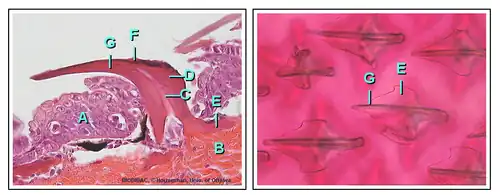 Placoid Scale (from Shark anatomy)
 -
 A ventral dissection of a pregnant female dogshark exposing its internal gill slits and internal spiracles. (from Shark anatomy)
 -

-
 Dorsal fin diagram with landmarks labeled. (from Shark anatomy)
 -
 Sharks swimming outside shark-proof cage with people inside (from Shark cage diving)
 -
 Distribution of highly sensitive ampullae of Lorenzini across the shark's head and rostrum. (from Shark agonistic display)
 -
 A dissected view of the unique four-chambered heart of the sharkChambers: Sinus Venosus, Atrium, Ventricle, Conus Ateriosus (from Shark anatomy)
 -
 In a milestone decision in 2013, CITES prohibited international trade in the fins of the scalloped hammerhead (pictured) and four other shark species. (from List of threatened sharks)
 -
 Great white shark at Isla Guadalupe, Mexico, August 2006. Animal estimated at 11–12 feet (3.3 to 3.6 m) in length, age unknown. (from Shark tourism)
 -
 Postural elements of the agonistic display of the Gray Reef Shark (from Shark agonistic display)
 -
Shark cage diving (from Shark tourism)
-

-
.jpg) Shark Anatomy (50693674756) (from Shark anatomy)
Shark Anatomy (50693674756) (from Shark anatomy) -
 Great white shark cages at Isla Guadalupe, Mexico (from Shark cage diving)
Topics
 See also
For additional lists of marine life-related featured articles and good articles see:
- WikiProject Cetaceans § Featured and Good Content
- Portal:Fish/Recognized content
- Portal:Marine life/Recognized content
Wikimedia
The following Wikimedia Foundation sister projects provide more on this subject:
-
 Commons
Free media repository -
 Wikibooks
Free textbooks and manuals -
 Wikidata
Free knowledge base -
 Wikinews
Free-content news -
 Wikiquote
Collection of quotations -
 Wikisource
Free-content library -
 Wikispecies
Directory of species -
 Wikiversity
Free learning tools -
 Wiktionary
Dictionary and thesaurus
Sources
-
 List of all portals
 -

-

-

-

-

-

-

-

-

-
 Random portal
 -
 WikiProject Portals